
 by
by 
Twenty years ago, two of my mentors taught me a lesson in sales I have never forgotten — and I didn’t even see it coming. My senior upline in an MLM back then — I’ll call them Howard and Allan — sat down with one of my prospects, a lady I knew from my neighborhood. I was fired up. I had two sharp, successful business partners pitching a great opportunity to someone I’d personally brought to the table. In my head, it was already a done deal.
It did not end the way I wanted. Not even close. But by the time I walked out that day, I had something more valuable than a new recruit. I walked out with business psychology — how to think about business and about people, how to read what the other person is really thinking, and how to use that to your advantage while protecting your own mindset. That’s what I want to pass down to you today, because there’s a whole generation in business right now that has never heard this taught out loud.
What Actually Happened in That Room
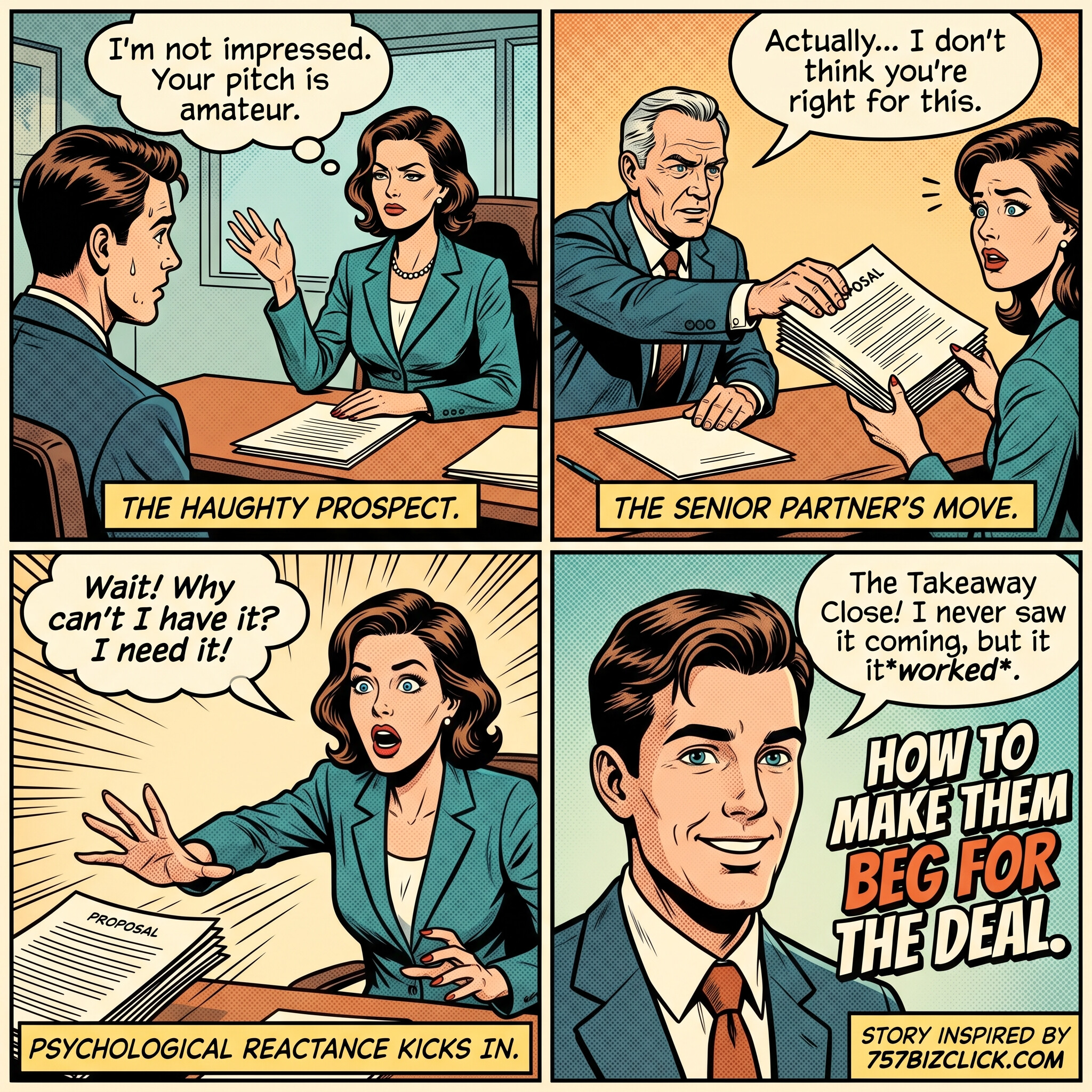
The meeting got off on the wrong foot. The lady was dismissive. A little haughty, honestly — poking at the pitch, talking down to my partners, treating the whole opportunity like it was beneath her. And here’s where the lesson lived: instead of pushing harder, instead of turning up the enthusiasm to win her over, one of my mentors did the opposite. He calmly pulled the offer back. Something to the effect of, “You know what — I don’t actually think you’re right for this.” And he meant it.
The whole room shifted. The energy flipped. The lady never did get into the business. Too bad. But I walked out with my head held high, standing next to two men who knew exactly what their opportunity was worth — and who weren’t about to beg anyone to take it. That move has a name. Salespeople call it the takeaway close — the “take-it-back,” the “negative sell.” And once you understand it, you’ll see it everywhere.
My Version of the Take-It-Back: Keep Your Value
So here’s how I teach it. The whole thing rests on one idea: always keep your value.
There’s a moment in the Gospel where Jesus tells his disciples that when a household rejects them harshly, they should shake the dust off their feet and keep moving (Matthew 10:14). Don’t argue. Don’t beg. Don’t shrink. Just wipe it off and go. That, to me, is the spirit of the take-it-back in business. When somebody harshly rejects your flyer, your card, your offer — “I don’t want to hear about this” — you don’t chase them. You take it back.
Now, a word of caution, because times have changed: don’t use the blunt, sarcastic version out on the street or in somebody’s face. It isn’t worth the trouble, and you want to stay safe out there. Use the gracious version instead — it’s just as powerful. You simply say: “All right — well, thank you, sir. I really appreciate it. You have a wonderful day.” And you keep it moving. I did exactly that one time, and the guy was so shocked he just stood there and looked at me in awe as I walked on to the next person. That’s the takeaway. You gave him nothing to push against, and you took your energy with you.
So why take it back at all? Because what that person is really doing is trying to put their negative mindset onto you, and to devalue something that is genuinely valuable to you. We don’t allow that. They’re trying to demoralize you — and we don’t allow that either. What you’re really saying, calmly and without drama, is: this is not for you.
There’s a term we use in business for this: you qualify people for access to what you have. And the second you start qualifying instead of begging, you turn the whole psychology upside down. Because when you walk up to someone with an offer, a card, a cold call — they automatically assume you need them. That you want it so bad. That you’re desperate. The actual truth? I don’t need you. I’m not desperate. I’m only looking for people who actually want what I have, who need it, and who have the right mindset to use it. If that’s not you, it’s okay — we’re just not a match. And I will not let you treat me like that. That’s a mindset, and it’s the most important thing I can hand you.
Why It Works: The Psychology Behind the Mindset
Here’s the part that took me years to fully appreciate: this isn’t just hustle talk or street wisdom. It’s measurable, documented psychology. Howard and Allan were running a play that scientists have studied in a lab.
The engine underneath it is something researchers call psychological reactance. Psychologist Jack Brehm formalized it back in 1966: when a freedom or an option gets threatened or taken away, people don’t shrug it off — they want it more, sometimes irrationally so. The instant that offer got pulled back, the prospect’s brain reclassified it from “something being pushed on me” to “something I might lose.” And we are wired to chase what we’re losing.
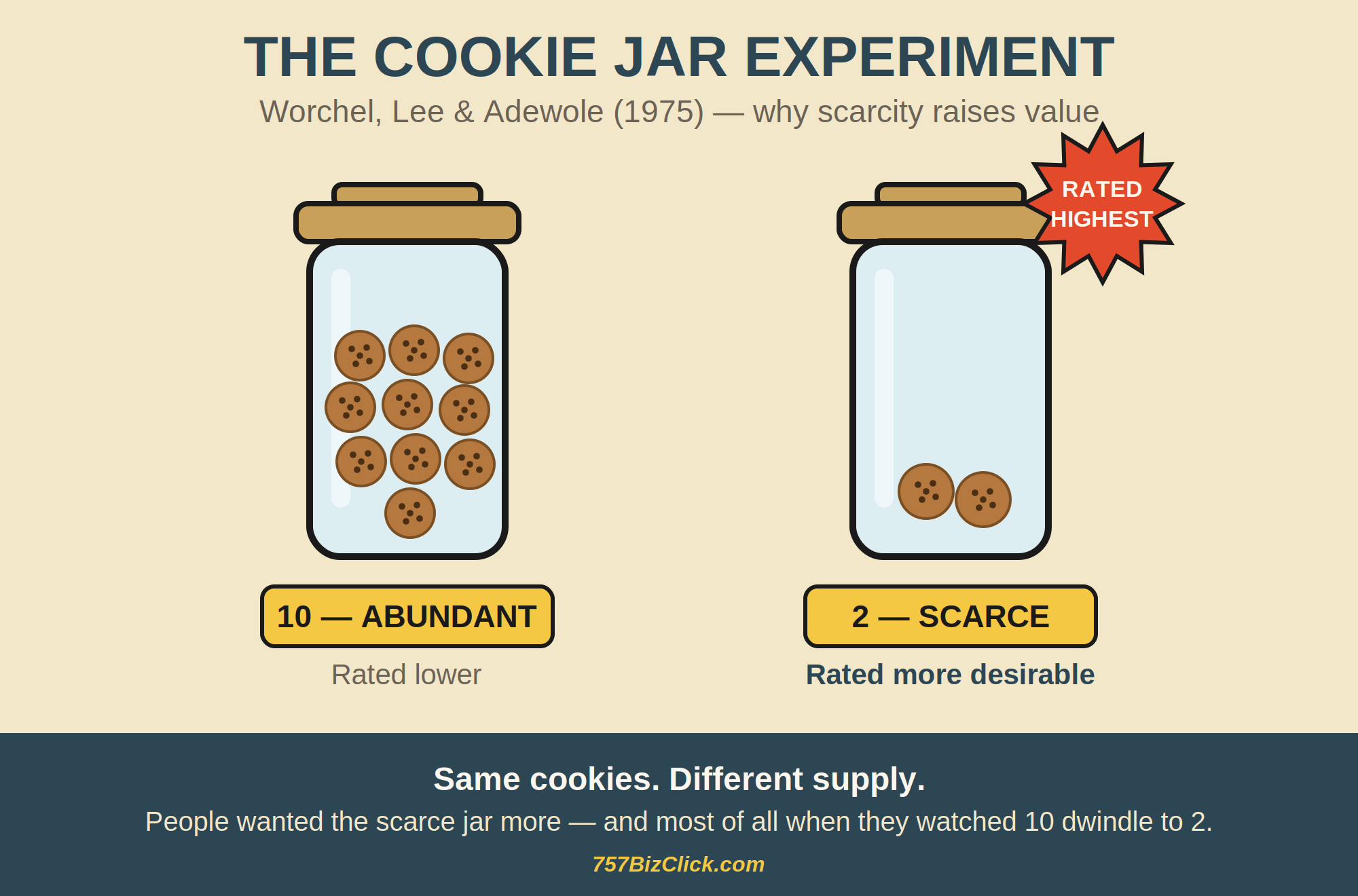
There’s a famous experiment that is basically my story run in a lab — the one in the image above. In 1975, researchers Worchel, Lee, and Adewole had people rate cookies pulled from a jar. Cookies in a jar holding only two were rated more desirable than the identical cookies in a jar of ten. That’s plain scarcity. But here’s the kicker: when people watched a jar of ten get reduced down to two, they rated those cookies highest of all — higher than the ones that had been scarce the entire time. The act of taking away beat scarcity by itself. That is the takeaway close, measured with a stopwatch and a clipboard.
Stack two more forces on top. First, loss aversion. Daniel Kahneman and Amos Tversky’s prospect theory (1979) showed that losses hit roughly twice as hard as equivalent gains — losing a hundred dollars stings about twice as much as finding a hundred feels good. Once a prospect mentally “owns” your opportunity, pulling it back lands as a loss, which is a far stronger motivator than the upside you were originally selling. Second, status and frame. Robert Cialdini folded all of this into his 1984 classic Influence, naming scarcity one of the core principles of persuasion — the simple “if it’s hard to get, it must be worth something” shortcut our brains love to take. You can read a clean breakdown of his principles over at Cialdini’s own Influence At Work.
Put it together and you understand exactly what my mentors did. A normal pitch puts the salesperson in the low-status, hat-in-hand seat. The takeaway flips the polarity so the prospect is the one trying to qualify. But — and this is everything — it only works when you genuinely behave like it’s true.
A Lineage of Closers: From Ziglar to Cardone
None of this is new. The take-it-back runs straight through the whole lineage of sales craft. Door-to-door salesmen used it. The old “puppy dog close” — let them take the puppy home for the weekend and just try to bring it back — is a cousin of it.
The legends built careers on the principle that you sell from strength, never from need. Zig Ziglar taught that selling is a transfer of conviction, and that the surest path to your own success runs through helping enough other people reach theirs — you don’t chase, you serve from a position of belief. If you want to study the master, his timeless work on the art of the sale is worth every minute: Zig Ziglar on closing the sale. Tom Hopkins codified these closes in How to Master the Art of Selling (1982). Jordan Belfort wired them into his “Straight Line” system. And the loud, modern heir to all of it is Grant Cardone — whose entire ethos is total conviction and complete detachment from the outcome. Cardone’s “10X” energy is really the same lesson Howard and Allan taught me quietly in that room: the person who believes 100 percent, and who is not the least bit desperate, wins.
And network marketing leaned on this harder than anyone, because in MLM the product and the opportunity are often the same thing, and exclusivity is rocket fuel. “We’re selective about who we let in” turns a recruiting pitch into an invitation. That’s the legacy I came up in — and it still works.
The Takeaway Close in the Online Age
Here’s where it gets exciting for those of us building businesses today, because the take-it-back didn’t die when selling moved online. It scaled. It just changed costume.
Look around the internet and you’ll see it everywhere: the waitlist, the “apply to join” button, the course that opens for exactly five days and then closes the cart, the coach who says “DM me to see if you qualify.” Every one of those is the same exclusivity my mentors used — now running on landing pages instead of living rooms. The offer you have to apply for feels more valuable than the one being shoved in your face. Same psychology, new delivery.
If you’re a small business owner, this is really about pricing with confidence and refusing to discount the instant someone pushes back. The contractor who says “I’m honestly not the cheapest, and I’m booked out a few weeks — I might not be your guy” closes more and better work than the one who chases every tire-kicker and slashes his price out of fear. Qualify your leads. Protect your time. Your calm confidence is the pitch.
If you’re an online business owner, the move is to build offers people raise their hand for, and to let your content do the proving so you’re never begging for the click. That’s the whole game: become the person worth qualifying for.
Use It Right: The Honest Line
Now I have to be straight with you, because this tool cuts both ways. There is a real difference between honest qualification — “this genuinely isn’t a fit for you” — and manufactured scarcity built to manipulate. The first is good salesmanship. The second will eventually torch the trust your whole business depends on.
Regulators are watching the fakes, too. In its September 2022 staff report, Bringing Dark Patterns to Light, the Federal Trade Commission specifically called out the dishonest cousins of the takeaway as deceptive “dark patterns”: false low-stock claims (“Only 1 left!” when there are plenty), false demand messages (“20 people are viewing this” when nobody is), and baseless countdown timers that simply reset when they hit zero. These can be treated as unfair or deceptive practices under Section 5 of the FTC Act. And even though the FTC’s broader “click-to-cancel” rule was struck down on procedural grounds in 2025, the agency can still pursue fake urgency — and a growing wave of state laws and private lawsuits is picking up the slack. The lesson is simple: the masters use the takeaway when it’s true. Fake it, and you lose the one thing you can’t buy back.
The Mindset to Carry With You
So here’s what I want you to walk away with. The takeaway close isn’t really a trick — it’s a frame and a mindset. It says: this has value, I know it has value, and not everyone gets in. Know your worth. Qualify, don’t beg. Protect your mind from other people’s negativity. And when someone tries to devalue what you’ve built, shake the dust off and keep moving with your head held high. That lady never joined — and that was perfectly fine, because the offer was always worth more than her approval. Howard and Allan knew it without ever cracking a book. Now you know it too.
If you want to go deeper with one of the all-time greats, start with Zig Ziglar’s classic on the sale — it’s a masterclass in selling from conviction. And if you’re ready to turn this mindset into real income online — to learn how to drive traffic, build offers, and actually make sales on the internet — that is exactly what I’m building through Wealthy Affiliate. It’s where I learned to take everything you just read and put it to work on the web. Come build with me.
This is the first of a deeper series on sales and business psychology here at 757BizClick, so stick around — there’s a lot more coming. Until then: know your value, stop chasing, and make something happen.


Leave a Reply