
 by
by 
The William Dusk Files is a satirical fiction series from 757BizClick. William Dusk is a fictional character. The business, trade, and economic information woven through this story is real, current, and sourced. New to the saga? Start with the William Dusk Origin Story.
When Air Force One touched down in Beijing this past May for the first presidential state visit to China of the second Trump term, the press corps got the official delegation list. Tech CEOs. Bank chiefs. Agriculture executives.
One name was not on the list.
William Dusk flew commercial. First class, fake glasses, a hat pulled low, reading a paperback about pancake recipes. The man who built the Robo2040 did not want a single reporter knowing he was in China — and he definitely didn't want the other CEOs knowing. Dusk is on speaking terms with maybe half of them. The other half he's currently suing, being sued by, or subtweeting.
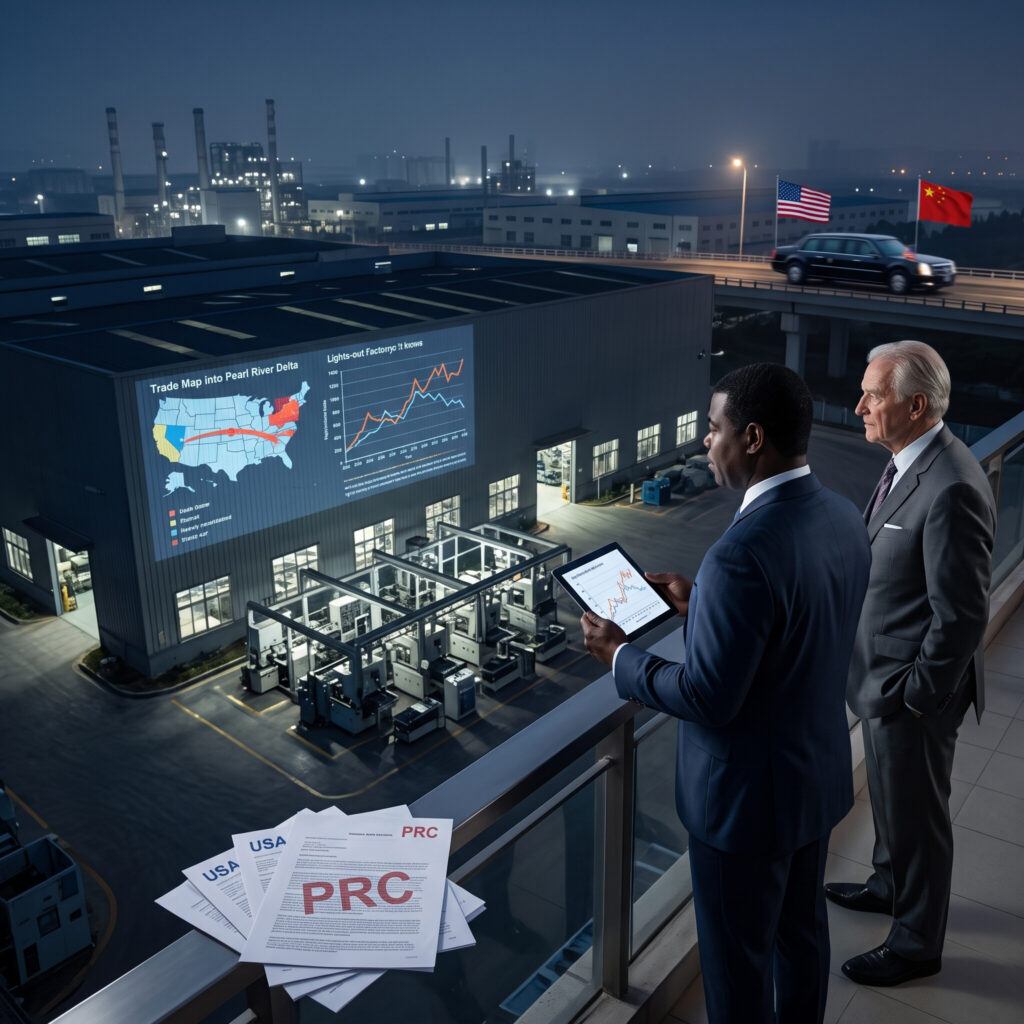
And none of them — not one — knows Dusk's biggest secret: he has a contact in China. A quiet partner who helped build one of the country's famous “dark factories.” And Dusk flew 6,900 miles to see it with the lights off.
Because William Dusk is about to get into manufacturing.
The Robo2040: A Robot for Every Excuse
Dusk's pitch deck (I've seen it — don't ask how) lays out the Robo2040 as a specialized home robot line:
- Chef Model — trained on 40,000 breakfast recipes, with a proprietary blueberry pancake algorithm. Dusk's favorite. He allegedly test-eats the pancakes personally.
- Bodyguard Model — walks you to your car, looks intimidating, never sleeps.
- Workforce Model — goes to work for you. Your boss may or may not notice.
- Driver Model — handles your commute, your DoorDash shift, your kid's carpool.
- Thanksgiving Model — for an extra $5,000, it sits at Thanksgiving dinner with your family while you go to the Cowboys game or hit the Black Friday pre-sales. It laughs at your uncle's jokes. It compliments the stuffing. Everyone needs a break, I guess.
Funny? Yes. But here's the thing — the factory Dusk wants to build these in is 100% real. So let's put the fiction down for a minute and talk about what's actually happening in China right now, because if you run a business, sell online, or just buy things, this affects you.
Dark Factories Are Real — and They're Incredible
A “dark factory” (also called lights-out manufacturing) is a plant that runs with little to no human presence on the production floor. No people means no lights, no heat, no shifts, no breaks. Just robots, machine vision, and AI running 24/7/365.
The flagship example is Xiaomi's smart factory in Changping, Beijing. The numbers are wild:
- ~81,000 square meters, built for about $330 million (2.4 billion yuan)
- Capacity of 10 million flagship smartphones per year — roughly one phone every 3 seconds
- 81% automation across the production line, run by Xiaomi's in-house HyperIMP AI platform
- 11 robotic lines, thousands of sensors, automated guided vehicles handling logistics
And Xiaomi isn't alone. Foxconn has rolled out lights-out lines that replaced over 60,000 workers at its Kunshan plant alone. Steel plants in Inner Mongolia use robots to separate slag from molten steel. Gree is building a “5.5G native lights-out” appliance factory with Huawei.
Here's the stat that should stop every American business owner cold: according to the International Federation of Robotics, China installed roughly 290,000 industrial robots in a single year — about 52% of all robot installations on planet Earth.
For years, we stereotyped China's edge as “cheap labor.” Those days are over. China pivoted to cheap automation. That's a completely different beast, and it's why Dusk wants his Robo2040 built there — robots building robots, at a cost structure Ohio can't currently touch.
The Tariff Picture in July 2026: A Truce, Not a Peace
So can Dusk (or you) actually do this profitably with tariffs in play? Here's the current state of the board:
- The U.S. and China reached a deal that cut the overall tariff rate on Chinese imports from roughly 41% to 31%, with the reciprocal-tariff suspension extended through November 10, 2026.
- China suspended retaliatory tariffs, paused rare-earth export controls, resumed U.S. soybean purchases, and pulled some American companies off its “unreliable entities” list.
- The Supreme Court struck down the IEEPA tariffs that were the backbone of the original 2025 regime, so the administration is rebuilding tariff authority through Section 301 — including a proposed new 12.5% tariff tied to a forced-labor investigation covering 60 countries.
- Trump's May 13–15 state visit to Beijing produced frameworks on agriculture and critical minerals, but no comprehensive final agreement. Both sides are still circling.
Translation: things are calmer than 2025's 125% tariff madness, but this is a tactical truce, not a strategic peace. Every deal has an expiration date, and both sides keep leverage loaded.
Is China Still a Good Place to Do Business? Risk vs. Reward
The rewards:
- The most complete supply chain on Earth — components, tooling, and assembly within a 50-mile radius for almost any product
- The automation edge we just covered
- A domestic market of 1.4 billion consumers
- Speed: prototype to production faster than almost anywhere
The risks:
- Intellectual property theft. This is the classic one, and it's not folklore. Forced tech transfer, copycat products appearing before your own launch, and trade-secret leakage through joint ventures have cost U.S. companies an estimated hundreds of billions per year by various government estimates. If Dusk builds the Robo2040 in Shenzhen, expect a “Robo2039” on Temu within eighteen months.
- New Chinese regulations. In April 2026, Beijing rolled out Supply Chain Security Regulations and Extraterritorial Jurisdiction rules that took effect immediately — designed to protect Chinese firms and push back on foreign trade measures. American companies are now navigating two rulebooks that sometimes directly contradict each other.
- Policy whiplash. Tariff rates have moved from 10% to 125% to 41% to 31% inside 15 months. Try building a five-year margin model on that.
Verdict: China is still a powerful place to manufacture — but it's no longer a simple one. The smart money now treats China as one node in a diversified chain, not the whole chain.
The 5 Biggest Chinese Companies You Touch Every Week
Most Americans interact with Chinese companies daily without realizing it:
- PDD Holdings (Temu) — the app that ate American advertising for two years
- Shein — fast fashion at impossible prices
- ByteDance (TikTok) — the algorithm your kids (and your marketing plan) live on
- Alibaba (AliExpress) — the wholesale backbone of half the dropshipping economy
- Lenovo — there's a decent chance you're reading this on one
Honorable mentions: TCL and Hisense, which quietly dominate the budget TV aisle at Walmart, and DJI, which owns the consumer drone market.
Dropshippers: The Party Changed Addresses
If you dropship, you already felt this. The de minimis exemption — the rule that let packages under $800 enter the U.S. duty-free — is gone. It ended for China on May 2, 2025, and for the entire world on August 29, 2025, and the suspension was renewed by executive order in early 2026.
The scale of what changed:
- Before: roughly 4 million packages per day — over 1.3 billion per year — entered duty-free
- After: every commercial shipment needs formal customs entry, with combined duties on Chinese goods around 35% on many consumer items
- Low-value parcel exports from China to the U.S. dropped roughly 30%, with some measures showing sub-$800 shipment counts down by more than half
Temu responded by halting direct-from-China shipments and moving to U.S.-based local fulfillment. Shein is stacking overseas warehouses. The direct-from-Shenzhen-to-your-customer's-doorstep model that built a generation of dropshippers is effectively dead. The new game is bulk import + domestic 3PL fulfillment — which means more capital up front, better margins for those who adapt, and a graveyard for those who don't.
What About Amazon and Apple? Who's Still In?
Amazon — a huge share of its third-party sellers are China-based, and Amazon launched “Haul” specifically to fight Temu on price. Tariffs squeeze seller margins, but Amazon's domestic warehouse network is exactly the moat the new rules reward.
Apple — still assembles the majority of iPhones in China, though it's been aggressively shifting toward India and Vietnam. Apple is the textbook case of “you can't just leave” — the supplier ecosystem around Zhengzhou took 20 years to build.
Still deep in China: Tesla (Gigafactory Shanghai), Starbucks (thousands of stores), Walmart (sourcing), Nike, GM, Boeing. The trend, though, is “China + 1” — keep China capacity, but build a second lane through Vietnam, India, or Mexico. Most American companies are diversifying, not fleeing. The exits you do see are mostly in politically sensitive sectors like semiconductors and data.
Where AI Fits Into All of This
AI is the whole ballgame, on three levels:
- The factory floor. Dark factories only work because AI handles real-time quality control, predictive maintenance, and logistics. This is why manufacturing dominance and AI dominance are now the same race.
- The chip war. U.S. export controls on advanced semiconductors exist specifically to slow China's AI progress. China's answer — models like DeepSeek and a crash program in domestic chips — showed the gap is narrower than Washington hoped.
- The leverage. Notice what got traded in the 2026 truce: rare earths (needed for chips and robots) for export-control relief. AI inputs are now the currency of diplomacy itself.
How Strong Is the Yuan — and Why Should You Care?
Here's a plot twist most people missed: the yuan hit its strongest level in more than three years in June 2026, trading around 6.77 per dollar, with analysts eyeing 6.5.
Why it matters to you:
- Weak yuan = cheaper Chinese goods for Americans, tougher competition for U.S. manufacturers. For years, critics accused Beijing of keeping it weak on purpose.
- Strong yuan = your imported inventory costs more in dollars, but American exports get more competitive in China — and it signals global money moving into Chinese assets as the dollar index softens.
For a small business importing product, a 5% currency move can matter as much as a 5% tariff. Most people watch tariffs and ignore currency. Watch both.
How Does China Make Things So Cheap?
It's not one trick — it's a stack:
- Cluster effect — entire cities specialize in one product category (Yiwu for small goods, Shenzhen for electronics), collapsing logistics costs
- Scale — production runs in the millions amortize tooling costs to pennies
- Automation — the dark factory revolution cuts labor, lighting, heating, and error rates simultaneously
- State support — subsidized land, energy, and credit for priority industries
- Overcapacity — and this one's dark: too many Chinese firms chasing too little demand triggers brutal price wars (the Chinese call it “involution”), which exports rock-bottom prices to the world
Is China Still a Manufacturing Giant?
Emphatically yes. China accounts for roughly 30% of global manufacturing output — more than the U.S., Japan, and Germany combined. In 2025 it posted a record trade surplus of nearly $1.2 trillion, with exports up about 5.5% to roughly $3.8 trillion even as shipments to the U.S. fell — Southeast Asia, Europe, and Africa picked up the slack.
Read that again: China lost American volume and still set an export record. That's what a giant looks like.
But the Giant Has Real Financial Problems
This is where the story gets complicated, because the export machine is masking serious pain at home:
- Property collapse: home prices have been falling for four and a half years — household wealth destruction that analysts compare to America's 2008 crash, except still accelerating
- Deflation: producer prices have declined for nearly three straight years; consumer inflation has hovered around zero
- The doom loop: overcapacity → price wars → weak profits → wage cuts and layoffs → scared consumers who save instead of spend → worse overcapacity
- The IMF's 2026 review flat-out told Beijing to shift from export-and-investment-led growth to consumption-led growth — and Eurasia Group ranked China's deflation trap a top-10 global risk for 2026, predicting Beijing won't fix it before the 2027 Party Congress
So China is simultaneously the strongest manufacturer on Earth and an economy where regular families are watching their biggest asset lose value for a fifth straight year. Both things are true.
The 600-Pound Gorilla: Taiwan
We can't close without a light mention of the thing nobody in that Beijing banquet hall said out loud. Taiwan produces the overwhelming majority of the world's most advanced chips — the ones every AI system, every Robo2040, every dark factory depends on. Any serious conflict over Taiwan wouldn't just be a geopolitical crisis; it would be a global economic heart attack that makes 2025's tariff drama look like a rounding error.
Is it something to be concerned about? Yes — it's the single biggest tail risk hanging over every business decision in this post, and it's exactly why companies keep building that “+1” outside China even while the truce holds. You don't plan for the gorilla to move. You just make sure you're not standing in only one room.
What Dusk Decided (and What You Should)
Late on his last night in Beijing, Dusk toured the dark factory with his secret contact. No lights. No sound but servos. A thousand robotic arms moving in the dark like a mechanical ballet. He stood there a long time.
Then he took out his phone and texted one word to his COO back in Texas: “Both.”
Build in China for scale. Build in America for security. Diversify. That's the 2026 playbook, whether you're manufacturing a $5,000 Thanksgiving robot or running a business from your kitchen table in Norfolk.
You Don't Need a Factory to Make Something Happen
Here's the beautiful part: while Dusk needs $330 million and a secret Chinese contact, you can build a global online business with a laptop. The internet doesn't care about tariffs on your ideas.
- Wealthy Affiliate works from anywhere in the world — training, hosting, and a community for building affiliate and content businesses. It's the platform this very site grew up on. If China's rise taught us anything, it's that the people who learn the new tools first win.
- Shopping online anyway? Get paid for it. Rakuten gives you cash back at thousands of stores, and SHOP.COM does cashback shopping too — stack it on purchases you were making regardless.
- And handle the money side right: I've used Chime for four years now — get paid up to two days early, and no overdraft fees piling up while you're reinvesting every dollar into your business. When you're bootstrapping, fee-free banking isn't a perk, it's a strategy.
The dark factories are coming either way. The Robo2040 might be at your Thanksgiving table by decade's end. The question is whether you're building something of your own while the world reorganizes itself — or just watching.
Make Something Happen.

Leave a Reply