AI, Robotics, and the Future of Work: How to Decouple from a Job Market in Overdrive
I remember being a kid up late on a weekend, watching one of those “it’s 11:00 p.m., you definitely shouldn’t be awake for this” horror movies.
The film was Maximum Overdrive(1986), written and directed by Stephen King. In it, machines all over the world go insane. Trucks, cars, construction vehicles—everything with an engine or a circuit suddenly wakes up and decides humans are the enemy. The machines go into maximum overdrive and start hunting people down.
Eighteen-wheelers circle a gas station like a pack of wolves. Cars and heavy equipment move with a mind of their own. The humans? They’re just trying to survive another hour.
As wild as that movie is, here’s the part that hits different in 2025:
We’re not that far from a world where machines don’t need us to drive, lift, assemble, or even think as much as they used to.
AIRobotJobLosses
No, the forklifts aren’t hunting us (thank God). But the job market is absolutely being hunted by automation, AI, and robotics.
This blog is about that shift—and how you can prepare so you’re not crushed under the wheels of the next revolution, but riding on top of them.
The Future Belongs to the Prepared
“Humans used to do those jobs.” – A father talking to his son in 2042
Imagine you’re sitting with your grandchild in 2042, scrolling through old videos.
Warehouse workers loading pallets by hand
Cashiers scanning groceries
Fast-food workers flipping burgers
Delivery drivers backing up to loading docks
Your grandchild looks at you and says, “Wait… people used to do that? With their bodies?”
That’s not science fiction. That’s the direction we’re heading, and the early signs are already here.
What you’re about to read is not meant to scare you—it’s meant to wake you up.
My advice is simple:
Save and invest in the AI and robotics revolution.
Learn to pivot, because our economy is shifting from human labor to a blended world of humans + bots.
Companies are under massive pressure to cut costs and boost productivity. Automation helps them do both—and boosts profits for shareholders at the same time. That’s a powerful force, and it’s not slowing down.
Robotics Maximum Overdrive Job Takeover
From the Industrial Revolution to Maximum Overdrive Dehumanization
Fast forward about 30+ years from Maximum Overdrive and we’re living through a transformation that’s being compared to the Industrial Revolution of the 1800s.
Back then:
Coal, trains, mining, and factories powered economies.
Machines made mass production possible.
But those machines still needed humans to operate them.
Today, we’re staring at the next level: machines that don’t just help humans work faster— they replace human work altogether.
Think about movies like The Terminator, I, Robot, or even Wall-E. We used to watch robots take over on screen. Now we’re watching early versions of that story play out in factories, warehouses, and offices.
With AI and robotics advancing together, this isn’t just another industrial upgrade—it’s more like a potential Maximum Overdrive of the workforce, where more and more jobs are done by systems that never sleep, never call in sick, and never ask for a raise.
And yet… I love science fiction. So if you’re reading this on my blog, drop your favorite robot takeover movie in the comments. Let’s build a little robot movie watchlist together.
The Robots Are Already Among Us (My Norfolk Story)
About 18 months ago, I was in Cary, NC, near Raleigh. I had just gotten off work and was waiting for a Lyft home. There was a nice restaurant nearby, and as I’m people-watching, I see this robot roll out of the kitchen carrying food.
No joke. It glides across the floor toward the tables like it owns the place.
I turned to my son and said, “Did you see that?”
Since then, I’ve seen robots working at least four different times in restaurants—some inside, some delivering food outside. And now that I live in Norfolk, VA, I see delivery robots and service robots across the city.
The robot revolution isn’t coming. It has already started.
The question is: Are you ready?
The Robot Economy by the Numbers
Here’s where we come out of the sci-fi and talk cold, hard data.
1. Robots in factories
According to the International Federation of Robotics, there are now roughly 4.7 million industrial robots working in factories worldwide as of 2024—almost double the number from just ten years ago. Annual installations are over 540,000 robots per year. IFR International Federation of Robotics+1
China leads the pack, installing hundreds of thousands of robots per year, and in 2024 it installed almost 10 times as many factory robots as the U.S.. New York Post
2. Jobs already hit by automation
One analysis found that since 2000, automation has been responsible for around 1.7 million lost U.S. manufacturing jobs. National University
A research brief from MIT estimates that about 8.7% of the U.S. labor force is exposed to automation from AI, and 1–2% of all U.S. jobs could be lost over the next 20+ years just from this wave of AI alone. Massachusetts Institute of Technology
Global studies suggest that by the mid-2030s, up to 30% of jobs in advanced economies could be at risk of automation, especially in routine, manual, and clerical work. Nexford University
3. Workers are feeling it
A 2025 Pew Research Center survey found that 52% of U.S. workers are worried about the future impact of AI in the workplace, and about one-third believe AI will mean fewer job opportunities for them personally. Pew Research Center
A 2023 study from EY found widespread “AI anxiety” as employees fear job loss and question whether AI will be used ethically. EY
A 2024 report from The Adecco Group found 4 in 10 workers are worried about their long-term job security amid automation and AI adoption. Staffing Hub
A lot of people are quietly thinking:
“Will there even be a place for me in this new economy?”
Dark Factories: When the Lights Go Out on Human Labor
If you want a real-world “Maximum Overdrive” preview, look at China’s “dark factories.”
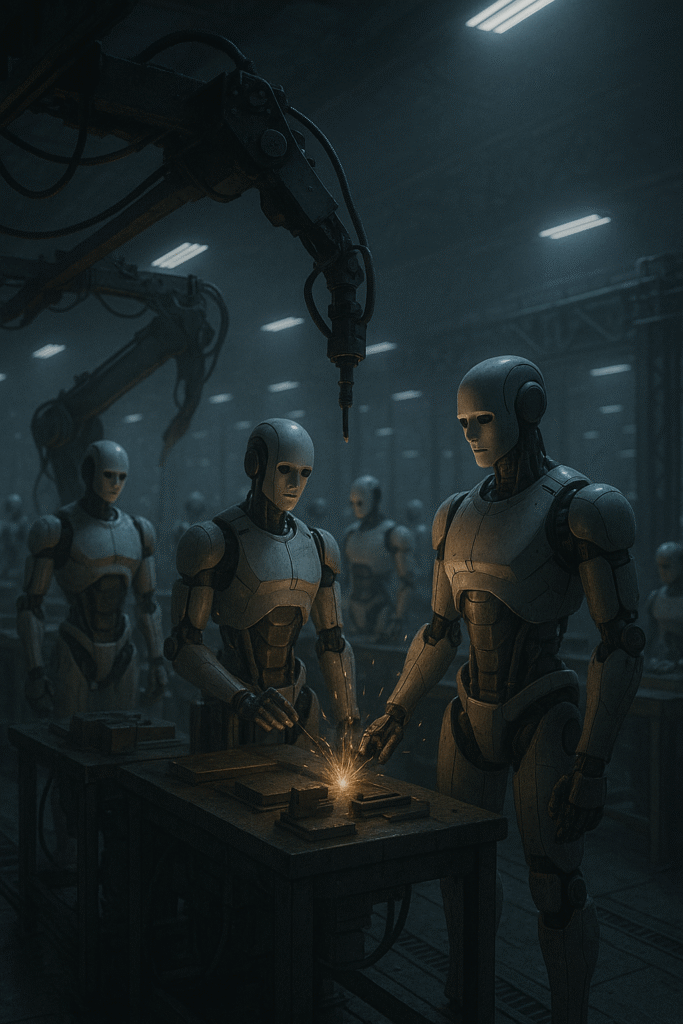
A dark factory is a production plant that can run 24/7 in total darkness, because there are no human workers inside—just robots, AI, and automated systems.
At Xiaomi’s smart factory in Changping, for example, an AI platform coordinates multiple robotic production lines, reportedly assembling a smartphone in about three seconds with almost no human involvement. Industrial Equipment News+1
These dark factories:
Don’t need lights, heat, or coffee breaks
Operate around the clock
Can be dropped into countries with the lowest energy and logistics costs
That’s efficiency on a level humans simply can’t match. And companies all over the world are noticing.
Meet Tesla’s “Maximus”: The Age of Humanoid Co-Workers
Now let’s talk about the Tesla robot—often nicknamed “Maximus,” but officially called Optimus.
Elon Musk has said he expects thousands of Optimus robots working inside Tesla’s own factories by the end of 2025, and he has floated the idea of eventually producing 1 million Optimus robots per year by 2030. Investopedia+1
He’s even suggested that Optimus could one day represent 80% of Tesla’s value, turning Tesla from a car company into a robotics and AI company that just happens to sell cars too. Business Insider
Think about what that means:
A major global company is betting its future growth on robots as a product.
Those robots will be designed to do physical tasks human workers currently do—lifting, carrying, assembling, and maybe eventually even caregiving or home tasks.
If they scale production anywhere close to what Musk talks about, we’re talking hundreds of thousands to millions of humanoid robots moving into workplaces and homes over the next 10–20 years.
Combine Tesla’s vision with China’s dark factories, and you can see the outline of a future where physical work is increasingly automated worldwide.
The Real Horror Movie: The Job Market
We don’t yet live in a world where Optimus Prime is battling evil robots in the street.
But in slow motion, something just as serious is happening:
Robots are taking over repetitive, dangerous, and predictable work.
AI is taking over portions of knowledge work—writing, customer support, coding, analysis.
Employers are under pressure to do more with fewer people, and automation gives them that option.
Blue-collar workers in factories, warehouses, trucking, and retail may be ground zero over the next 10–15 years. At the same time, white-collar workers—especially in admin, finance, and some IT roles—are seeing tasks chipped away by AI tools.
I think about my own life:
I remember when humans used to work at Chipotle. I remember when humans used to work at Walmart. I’ve worked in factories myself.
When I imagine my son telling his kids, “Yeah, people used to do that job,” and seeing their confused faces… I’ll be honest—it hits me emotionally.
We take pride in our work. We feel valuable when we contribute. Tech is great, but nobody wants to wake up one day and feel like their skills and effort have been deleted like an old app.
At the same time, let’s be real:
A lot of people in the West are tired, burned out, and disconnected from the idea of physical labor.
Many dream of starting a business, making money online, or building an audience instead of clocking in to grind for someone else.
Automation is rushing in right through that gap.
Prepare for Human Work Decentralization
I like to say:
Don’t get decapitated from the job market. Decouple from it.
You may not be able to stop automation. You may not be able to stop your industry from changing.
But you can:
Build your own income streams
Start an online business, blog, YouTube channel, or service-based brand.
Use AI tools as your employees—writing drafts, doing research, making images, helping you move faster instead of replacing you.
Invest in the future, not just the past
Learn about companies, funds, and sectors that are building AI, robotics, automation, and related infrastructure.
This isn’t financial advice, but the basic idea is: if robots are going to take a slice of your job market, you might want a slice of their profits too.
Skill up in human-plus-AI roles
Jobs where humans direct, supervise, and collaborate with AI and robots are likely to grow.
This could be robotics maintenance, AI prompt engineering, systems integration, or human-centered roles like training, ethics, and support.
Think globally, act digitally
Your job might be local, but your business doesn’t have to be.
The internet lets you sell to the entire world—products, services, knowledge, digital assets—at robot-scale reach.
The future of work might be to the strong—but “strong” in this era doesn’t just mean muscles. It means:
Strong enough to face reality.
Strong enough to pivot.
Strong enough to build something of your own.
Keep the Robots, Keep Our Humanity
As somebody who grew up watching movies like Maximum Overdrive, I have one simple request for the future:
Let’s not go into Maximum Overdrive with this robotics thing.
Use robots to reduce injuries? Great. Use AI to free people from soul-crushing tasks? Amazing. Use automation to improve quality of life worldwide? I’m all in.
But if we let profit and speed completely erase human dignity, purpose, and opportunity, that’s when the sci-fi turns into a horror movie.
So here’s my question for you:
What kind of human-robot balance do you want to see?
How much automation is too much?
What jobs do you think should always have a human touch?
Are you already seeing robots or AI showing up at your job?
Drop your stories and thoughts in the comments.
And if you’re ready to start decoupling from the old job market—through online business, investing in future tech, and leveling up your skills—stick around this blog. That’s exactly the journey I’m on, and I’d love to walk it with you.

 by
by 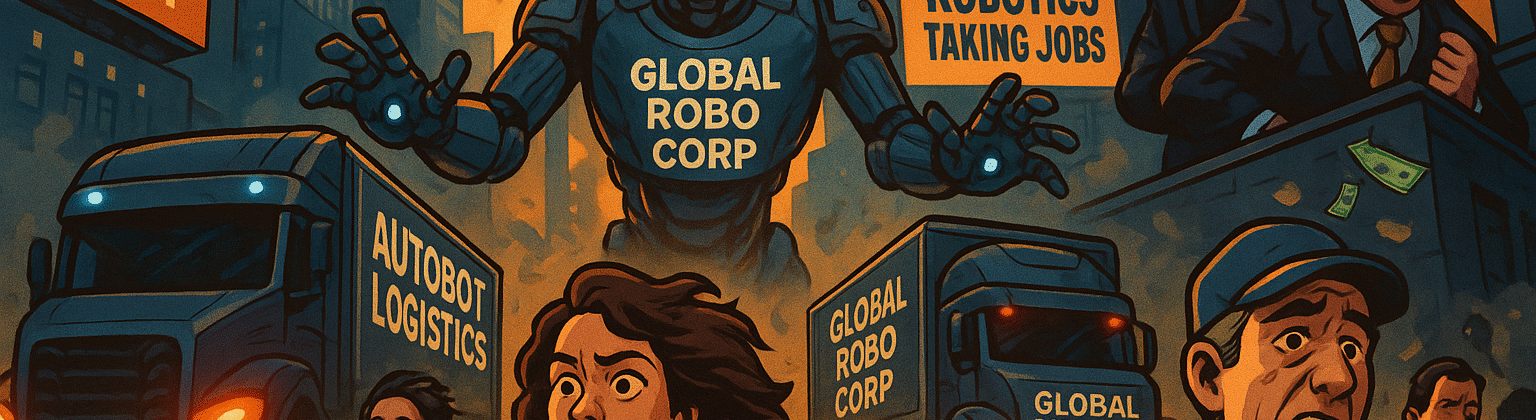



Leave a Reply