
 by
by 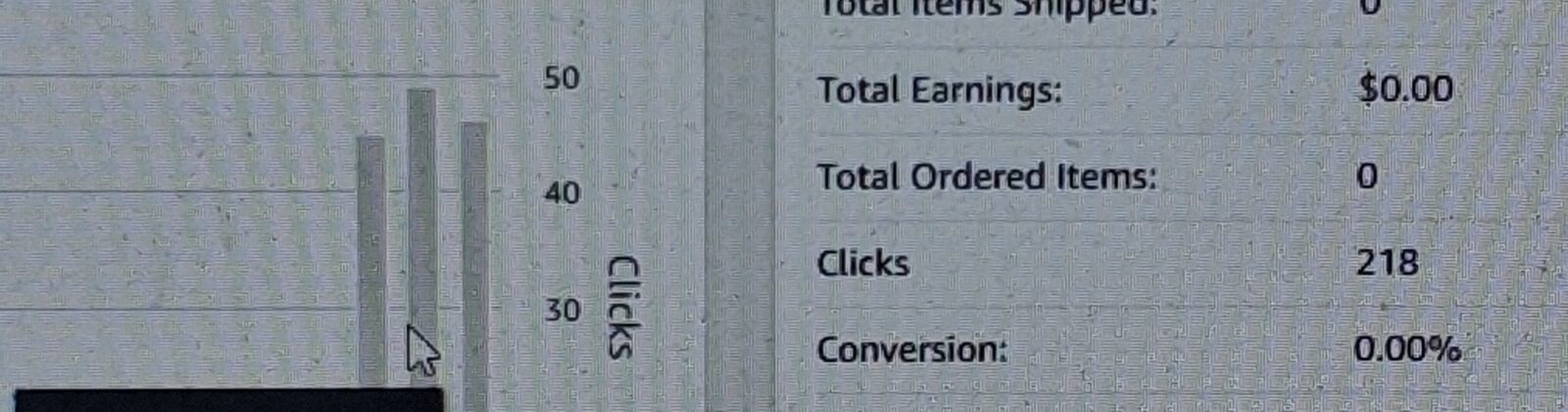
Three days ago I woke up, poured my coffee, and pulled up my Amazon Associates dashboard like I do every single morning. And I almost spit out that coffee. For the entire lifetime of my Amazon affiliate account, I have averaged maybe two or three link clicks a day. A good day was 15. A great day was 20. But the number staring back at me that morning was one I had never seen before: 46 clicks in a single day. The next day? 49. The day after that? Right around 50. My link clicks didn't climb — they exploded.
Then I scrolled down to the part of the dashboard that actually pays the bills.
Total Items Shipped: 0
Total Earnings: $0.00
Clicks This Month: 218
Conversion: 0.00%
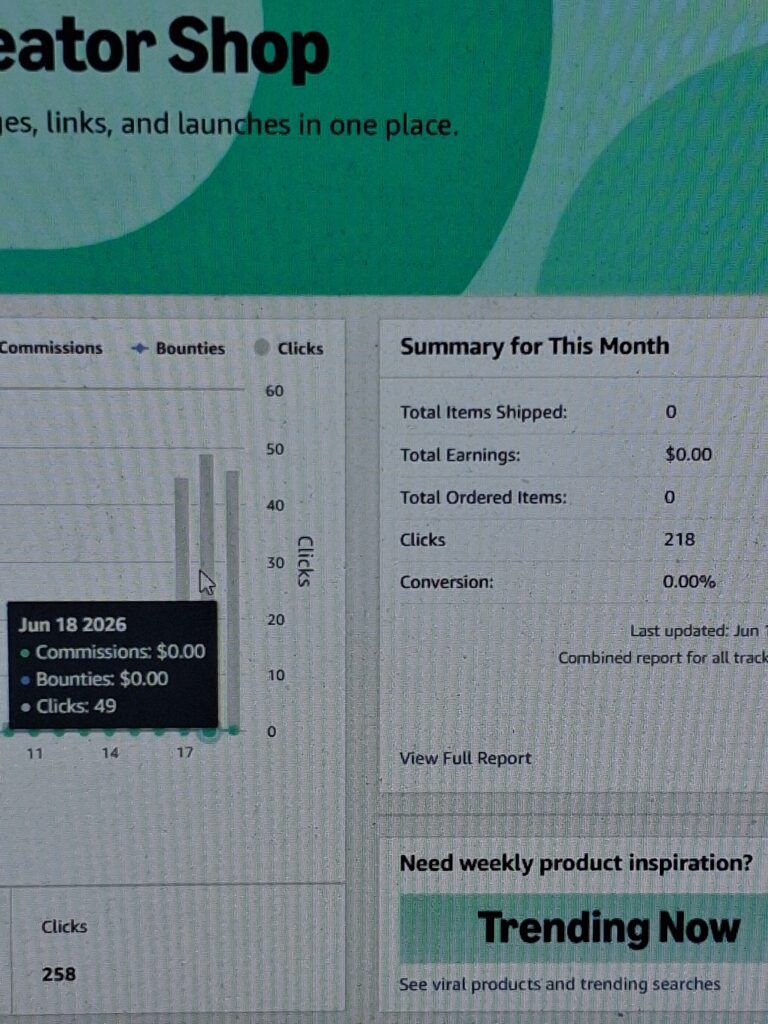
Two hundred and eighteen clicks this month, and not one red cent to show for it. Now here is the part most people get wrong. They see a screen like that and they panic. I smiled. Because in this business, a wall of clicks with zero sales is not a failure — it's a map. It is the single clearest signal you will ever get telling you exactly what's working, exactly what's broken, and exactly where the money is hiding. So let me walk you through what I found, what those numbers actually mean, and the fixes I'm putting in place right now. This one comes straight from my own dashboard to your playbook.
First, Why This Is a Great Problem to Have
I want you to reframe this before we go one step further, because your mindset here decides whether you quit or whether you get rich. There are really only three places you can be as an affiliate marketer:
- No clicks. You are invisible. Nobody is reading you, nobody is tapping, and you have no data to learn from. This is the worst spot to be in — and most people never climb out of it.
- Clicks but no sales. People are paying attention. Your hook is landing. You're just losing them somewhere between the click and the checkout. This is where I am right now.
- Clicks and sales. The machine is running. Now you just pour gas on it.
Going from zero clicks to 50 clicks a day means I graduated past invisible. The attention problem is solved. And here is the honest truth about how I solved it: I let artificial intelligence sharpen my copy. I fed the AI content that was already getting traction, had it tighten the verbiage and rewrite the hooks, and the clicks went up by more than 20 times. The AI understands human behavior at the level of cold numbers, and it writes to that behavior better than most of us can by feel. That is exactly why I keep telling you — one way or another, you have to be working with AI. It got me the attention. The sales are my job. Let me show you why those are two completely different jobs.
The Two Targets (And Why I Was Only Hitting One)
Every single affiliate sale is really two separate bullseyes, not one. And the mistake that's killing most beginners is thinking they're the same shot.
- Target #1 — The Click. This is attention. It's the hook, the headline, the thumbnail, the first two seconds. It answers one question: “Will you stop scrolling and tap?”
- Target #2 — The Sale. This is intent. It answers a completely different question: “Were you actually here to buy, and do you trust this enough to pull out your card?”
AI mastered Target #1 for me. Writing copy that earns the tap is a pattern-matching problem, and machines are elite at patterns. But AI did not automatically fix Target #2, because hitting the sale isn't about better words — it's about who you put in front of the offer and what you ask them to do. That's called targeting. And the numbers tell the whole story.
Across all Amazon Associates, Amazon's own published average conversion rate sits right around 8%. Industry guides peg buyer-intent content — the “best [product] 2026” and “[product A] vs. [product B]” searches — at roughly 8–14%. Casual, browse-y, “just here to be entertained” content usually lands at 2–5%. And even the rock-bottom floor for affiliate conversion is often cited around 0.5–1%.
Read that again. The floor is half a percent. I'm sitting at 0.00% on 218 clicks. That is not bad luck. When you fall below the floor, the dashboard is screaming one specific thing at you: the people clicking were never the people buying. So the real question becomes — who exactly is clicking my links?
Traffic Has a Temperature
Here is the concept that unlocked the whole mystery for me. Traffic is not all the same. Traffic has a temperature.
- Cold traffic is in entertainment and discovery mode. They're scrolling a feed, watching memes, swiping Shorts. They are not shopping. They're killing time. When something catches their eye, they might tap out of pure curiosity — but their wallet is nowhere near their hand.
- Warm traffic is in solution mode. They typed “best [product] for [problem]” into a search bar. They're reading a review. They're on your email list because they already raised their hand once. These people showed up with intent.
Now look back at that benchmark spread. Buyer-intent traffic converts at 8–14%. Casual browse traffic converts at 2–5%. Same products. Same Amazon. The only thing that changed is the temperature of the person clicking. That spread is the lesson: the temperature of your traffic sets the ceiling on your conversion before your copy ever gets a single vote.
So what happened to me is now obvious. The exact same fire-hot, AI-sharpened copy that wins a cold click cannot close a sale — because the person was never there to buy. They tapped, hit Amazon, realized they weren't actually shopping for anything, and bounced. Great copy, wrong temperature. And I have a strong suspicion about where most of that cold traffic is coming from.
The Shorts Placement Trap (You Were Right to Flag This)
I've been a lot more active across a lot more platforms lately — I launched a meme brand, I started posting on X, I jumped on Pinterest, and I've got a YouTube channel cranking out views. A big chunk of those mystery clicks, I believe, are coming off short-form video. And short-form is where the click-to-sale gap gets the widest. Here's why.
1. The mindset is wrong for buying.
Shorts viewers browse passively, make snap decisions in the first two seconds, and very often watch while doing something else entirely. It's discovery-driven, not search-driven. They are not hunting for a solution — they're entertaining themselves. You cannot sell a fuel additive to a man who's only on his phone to laugh.
2. The link friction is brutal.
Shorts don't let you put a clickable link inside the video. To get to your affiliate link, the viewer has to break out of the swipe, go digging in the description or hunt through your channel, and find it manually. Every single extra step bleeds off intent. By the time they find the link, the impulse is gone.
3. The commitment gap is real and measurable.
One 2026 comparison found that a buyer-intent long-form viewer — someone watching a full “best laptop 2026” review — subscribes around 10% of the time, versus about 1% for a Short. That same gap shows up in sales. Short-form viewers just don't commit at the moment of the swipe.
But hear me clearly, because this is the part that turns the trap into a strategy: Shorts are not useless. They are the best reach-and-discovery machine on the internet right now. As one agency put it, the money from Shorts doesn't come from the view — it comes from what happens after the view. Shorts build the audience. Long-form video, email, and warm follow-up close the sale. You don't kill the Short. You stop asking it to do a job it was never built for.
And placement inside the Short matters more than people think. One analysis found that Shorts which drop the product mention in the first 10 seconds saw roughly 22% higher affiliate sales than those that buried it at the end. Where and when you make the ask changes the outcome. So let's get into the actual fixes.
How I'm Fixing the Target — My Conversion Playbook
Here is exactly what I'm changing this week. Steal all of it.
Fix #1 — Match the Offer to the Temperature
You do not propose marriage on a first date. Cold traffic gets a low-friction, low-commitment ask. This is the single biggest lever, and it's why I'm now pointing cold scroll traffic toward a small, low-cost entry product instead of a big-ticket item. For my wellness channel, that means sending people to the 13 oz “try size” instead of the full-size jug. Lower price means lower risk, which means higher conversion. A try size turns a curious scroller into a first-time buyer — and a first-time buyer into a repeat customer down the road. Match the size of the ask to the warmth of the person.
Fix #2 — Pre-Sell Before You Ask for the Click
The click should come at the end of a problem-to-solution story, not before it. Give the context, build the desire, paint the picture of life with the problem solved — then drop the link. A warm click converts. A cold curiosity-click bounces. Your job is to warm the click up before it ever happens.
Fix #3 — Send People to a Bridge, Not a Cold Storefront
Stop firing raw traffic straight at an Amazon page. Warm them up on your own turf first — a blog post, an honest review, a short landing page that frames the product and sets expectations. Then the Amazon click becomes the last easy step instead of the first cold one.
Fix #4 — Match the Product to the Promise
If your content is about X, the product had better solve X. Mismatched offers are the fastest road to a wall of dead clicks. Run the audit on yourself: does what they clicked from actually line up with what they land on? If a meme sends someone to a supplement page with no connective tissue, that click was dead on arrival.
Fix #5 — Own the Relationship (Capture the Email)
Here's the one that hurts. Most of those 218 clickers, I will never see again. That's renting attention. The real move is to own it — get the email, follow up, build trust, and sell over weeks and months instead of in one swipe. One cold click is a coin flip. An email list is a relationship that compounds every single day. This is the exact system I'm building, and it's the system Wealthy Affiliate teaches start to finish — traffic, funnels, email, and conversion all in one place. If you want to learn how to turn clicks into customers the right way, come build with me inside Wealthy Affiliate.
Fix #6 — Work the Cookie Like a Pro
Now the good news that keeps me feeding the machine. Amazon's affiliate cookie lasts 24 hours, and here's the kicker: you earn a commission on anything that person buys in that window, not just the product you linked. If they add your item to the cart, that can ride even longer before checkout. So even a “wrong” click carries residual value. Volume plus the cookie means some of those 218 clicks can still turn into surprise commissions on products I never even mentioned. Don't stop creating. Keep feeding it.
This Problem Is Older Than the Internet
If you think “lots of clicks, no sales” is some new digital-age glitch, let me put your mind at ease. This problem is over a hundred years old. The platform is new. The psychology is ancient.
Back in 1898, an advertising man named E. St. Elmo Lewis mapped out what we now call the AIDA funnel — Attention, Interest, Desire, Action. Look at where I am on that map: I'm winning Attention, Interest, and Desire. Those are the clicks. I'm losing Action. That's the sale. Same funnel that's been around since the horse-and-buggy era, brand-new platform.
In 1923, Claude Hopkins wrote Scientific Advertising and preached one gospel above all others: measure your response, don't guess. The man would have wept tears of joy over a dashboard that tells you clicks versus sales in real time. The discipline of test, measure, and refine is the entire game — and it's a century old. The old direct-mail legends knew a single mailing could pull a mountain of responses and still lose money if the offer didn't fit the list. “Clicks with no sales” is nothing but the digital version of a hot mailer sent to a cold list.
Nothing new under the sun. The tools change. Human nature does not.
Where This Is All Headed (AI Just Moved the Goalposts)
Now let me put on my future glasses, because this is the part that changes how you should build for the next five years.
AI just made winning the click easy and cheap. Anybody can now generate a scroll-stopping hook on demand — that is literally what happened to my numbers. But here's the catch that most people are about to learn the hard way: when everyone can win the click, the click stops being the edge. Attention is being commoditized in real time. As every feed on earth floods with AI-optimized hooks, attention gets cheaper by the day — and trust gets more expensive.
So the marketers who win the next five years won't be the ones renting the most attention. They'll be the ones who own the most trust. Email lists. Real audience relationships. A brand people actually believe in. The click is rented. The relationship is owned. Big difference.
Here's my prediction: as AI-generated answers and zero-click feeds keep growing, the gap between browsers and buyers is going to get wider, not narrower. And owning a list and an audience is going to become the single most valuable asset in online business — more valuable than any one viral post. That's exactly why I'm pouring my energy into email capture and platforms I control, not just chasing the next viral click.
And yes — you have to be working with AI to compete at all. AI got me 50 clicks a day. My job is to build the funnel that turns those clicks into customers. Human plus AI is the winning team. One without the other leaves money sitting on the table every single day.
Make Something Happen
So let's bring it home. Clicks are only half the game. The sale is the other half. And the bridge between them is one word: targeting. Match the temperature of your traffic. Lower the friction of your ask. Own the relationship instead of renting attention. Work the cookie. And then refine, refine, refine — because you are going to hit on something, and when you do, your only job is to study why it worked and pour gas on it. That right there is how a side gig quietly becomes a business.
If you want to put this into practice today, grab the 13 oz try size here and see for yourself why a low-friction offer is the smartest first ask for cold traffic. And if you're ready to learn the full system — traffic, funnels, email, and conversion under one roof — come build with me inside Wealthy Affiliate. I'll see you on the inside.
Keep creating. Keep refining. And whatever you do — Make Something Happen.


Leave a Reply