
 by
by 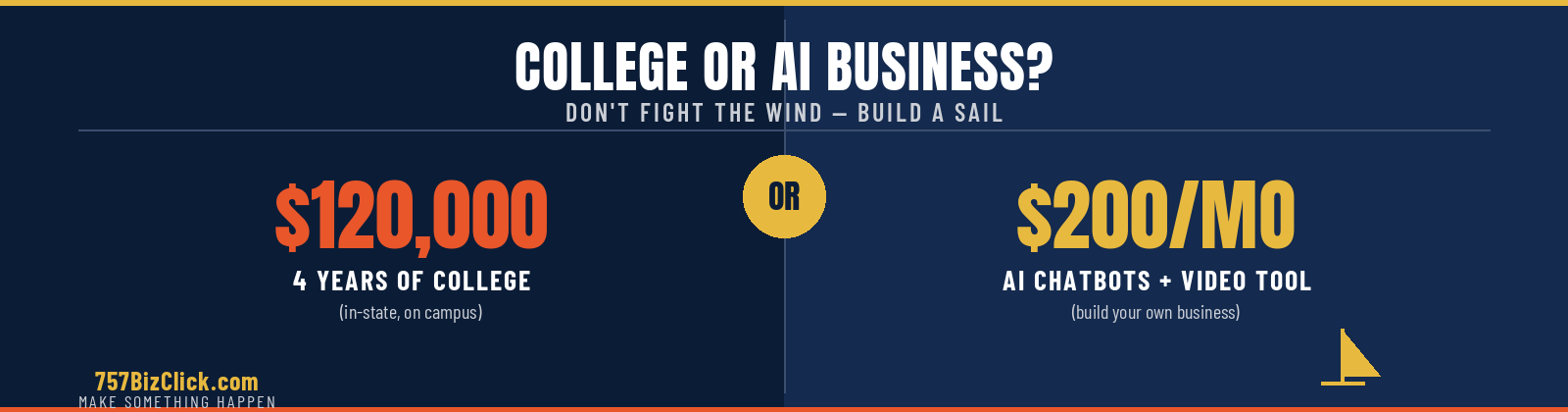
So it's finally done. My car wrap is DONE. I've been chasing this thing since August of last year — almost a full year of life, bills, sending my son to Christian school, and a whole lot of forces working against me instead of with me. And in the last six weeks of that journey, something happened that changed how I think about education forever. I built an email list, a landing page, and a complete Start Page for my website — things I could NOT figure out in 14 years of online business — in about 72 hours of actual work time. My professor? An AI chatbot that costs less per month than a tank of gas. So before you sign up for that expensive four-year college, I have a question for you, and for your parents too: Is college even for you? Or are you more like LeBron James, Kobe Bryant, and Kevin Garnett — ready to skip college and go straight into your chosen profession? Except in this case, your basketball is AI. Let's talk about it. Make Something Happen!
Who This Is For
This blog is for any teenager in high school — or even a younger teen, like my son who's just starting high school — and their parents. If you're staring at that college decision wondering “is this for me?”, I want to help you think it through, using my own adventure getting a car wrap on my Genesis as the backdrop. Could I have gotten the wrap done without AI? Sure — but it would have been bumpy and way more stressful. Could I have built my award-winning Start Page without AI? Not a chance. (OK, it's not award-winning. But to me it's a masterpiece.)
Full disclosure: I'm biased. I never went to college — I went into the military, and now I'm building my online business with AI. It's fun, rewarding, and powerful. My AI chatbot and I take long walks in the park. (That's a conversation for another day.) But for this post, I'm dropping my bias and giving you the real 411 — the actual numbers, what the experts are calculating, and what everyday people are feeling. Because sentiment tells you things the stats can't. What people are seeing and sensing on the ground is often a hint of what's coming.
The Mood Has Flipped — And Fast
Let's start with sentiment, because this shift is stunning.
In 2013, 53% of Americans said a four-year degree was worth the cost. In 2017, the country was basically split — 49% worth it, 47% not. By November 2025? An NBC News poll found only 33% of registered voters say a four-year degree is worth the cost, while 63% say it is NOT — because “people often graduate without specific job skills and with a large amount of debt to pay off.”
Read that again. In about a decade, America went from “college is the ticket” to two-thirds saying “no thanks.”
Confidence in higher education as an institution tells the same story. Gallup and the Lumina Foundation have tracked it since 2015, when 57% of Americans had strong confidence in colleges. By 2026, that number is down to 38%. The three reasons people give: cost, campus politics, and doubts that colleges actually prepare students for the workforce.
Now here's the plot twist — and this is why sentiment matters. Roughly 71% of actual college graduates say their education was worth it, and 75% of Americans still call higher education “a good investment.” So it's not that people think college doesn't work. It's that they don't trust the PRICE anymore. Lumina found that 82% of student loan borrowers are moderately or very worried about repaying their loans, and only 18% of adults without a degree think four-year tuition is fairly priced. The product isn't broken. The price tag is.
What College Actually Costs (The Real Numbers)
Per the College Board's 2025-26 data, here's the average yearly sticker price for tuition and fees:
- Public 2-year community college (in-district): $4,150
- Public 4-year, in-state: $11,950 (total cost of attendance with housing, food, and books: $30,000+)
- Public 4-year, out-of-state: $31,880 (total cost of attendance: $50,000+)
- Private nonprofit 4-year: $45,000 (total cost of attendance: $65,000+)
So that $40,000–$80,000 four-year figure I keep mentioning? That's actually the CHEAPEST path — in-state public tuition. Go private or out-of-state and you can blow past $200,000 for four years.
And the debt follows you home. Americans owe $1.87 trillion in student loans across nearly 43 million borrowers. The average bachelor's grad who borrows walks out with about $29,560 in debt, and today's federal loan rates sit around 6.5% — more than DOUBLE the 2.75% rate from 2020. Every $10,000 borrowed costs roughly $113 a month for ten years, and you'll pay back about $13,560 total. And here's the kicker: new federal law (the One Big Beautiful Bill Act) just capped Parent PLUS loans at $20,000 a year and $65,000 lifetime per student starting July 2026. The government itself is saying: families, stop borrowing unlimited money for this.
America is broke, friends. Nobody is coming to pay off your student loans. That bill will be waiting for you at graduation, right next to your diploma.
The Entry-Level AI Job Shock
Here's where the story gets serious — and where I need every parent and teenager to lean in.
The scariest scenario isn't “college is expensive.” It's this: you go IN to college with a solid plan, AI disrupts your field while you're studying, and you come OUT four years later into a job market that no longer needs entry-level people in your major — with the debt still due. That's not a hypothetical anymore. Stanford researchers analyzed payroll records from millions of American workers, and here's what they found has ALREADY happened since late 2022:
- Software developers aged 22–25: employment down nearly 20%. Meanwhile developers aged 30+ at the SAME companies grew 6–12%. The jobs didn't vanish — the bottom rung of the ladder did.
- Customer service: hiring down about 15%, with AI boosting productivity 14% in that field (translation: fewer humans needed per ticket).
- Computer science graduates now face 6–7% unemployment — nearly double the national average — and entry-level remote-friendly tech postings have fallen 71% since 2022. Students see it too: CS enrollment just dropped 8–11% in a single year, the steepest decline of any major on record.
- Journalism: newspaper jobs are down more than 75% since 2005, and 2026 alone brought massive cuts at the Washington Post (a third of the newsroom), Politico, Vox, and the Wall Street Journal.
The World Economic Forum surveyed 1,000+ employers representing 14 million workers, and their fastest-declining jobs list through 2030 reads like a catalog of classic “first jobs”: data entry clerks, bank tellers, cashiers, administrative assistants, bookkeeping and payroll clerks, graphic designers, legal secretaries, telemarketers.
No wonder graduating classes have been booing commencement speakers who bring up AI. Those students aren't being rude — they're being honest. They did everything right, and the first rung of the ladder got automated while they were paying tuition to climb toward it.
And you feel it in everyday life too. Go through a Taco Bell drive-through like I did a couple nights ago and you're talking to an AI. If the AI can't help you, the human who finally takes over isn't happy — and deep down they know their job could be next. Something to think about while you're deciding what to spend four years and $80,000 on.
Are You the LeBron James of AI Business?
Here's my first metaphor, and I mean it seriously. LeBron James skipped college. Why? Because making him sit in a classroom for four years before doing the thing he was already elite at would have been foolish. Him going to college would have been like LeBron at 18 taking a $60,000-a-year desk job at Microsoft. It just doesn't make sense for HIM.
Kobe skipped it. Kevin Garnett skipped it. (Shaq would tell you college helped his free throws — that's a joke, and if you've seen Shaq at the line, you know it's a good one.)
Now — and this is the honest 411 — most people are NOT LeBron. For most careers, the degree still pays: Georgetown University calculates a bachelor's degree is worth $2.8 million in lifetime earnings on average, and college grads out-earn high-school-only workers by more than $30,000 a YEAR at the median. That's real money and I won't pretend otherwise.
But here's what's new: for the first time in history, an 18-year-old with drive has a genuine third option that isn't college and isn't minimum wage. AI is a professor that works for you practically for free — 24 hours a day, never annoyed by your questions, teaching you the exact practical skill you need in seconds. I spent 14 years unable to build an email list. With AI as my professor, I learned it in about three days of actual work — opt-in page, backend infrastructure, the whole thing. I'm a pro at it now. I could teach YOU how to do it right now. How much would a human professor have charged me for that? Hundreds? Thousands? My AI professor cost me a monthly subscription.
So the question isn't “is college good?” The question is: are YOU the type who's ready to go pro with AI right now?
The Thought Experiment: 4 Years of College vs. 4 Years of AI Business
Let's run the numbers side by side. Same 4 years, two different paths.
Path A — College (public, in-state, living on campus):
Total cost of attendance runs $30,000+ per year. That's roughly $2,500 a MONTH. Over 4 years: $120,000 (or $48,000 if you commute and hit the sticker-tuition average, before aid). You graduate with a credential, a network, and — if you borrowed — a $300+ monthly loan payment for the next decade.
Path B — The AI Stack:
Three chatbot subscriptions (Claude, ChatGPT, Gemini or Grok) at roughly $20 each = $60/month. Add a serious AI video tool (Kling, Runway, or similar) at $60–$100/month. Call the whole stack $150–$200 a month, generously. Over 4 years: roughly $7,200–$9,600.
That's a 12-to-15X difference. For the price of ONE SEMESTER, you could run a full professional AI toolkit for four straight years — writing blogs, making videos, generating images, building landing pages, learning email marketing, studying business — while actually BUILDING something that's yours.
And here's the wild part: after 4–6 years of college plus a few years in your industry, if AI disruption catches your field, what do a lot of laid-off graduates end up doing? Making content on TikTok and YouTube titled “I got laid off because of AI — what now?” You might as well start making content NOW, without the debt.
Take it one step further. Take the $5,000–$10,000 you were going to put into freshman year and seed your own business instead. Better yet, get two or three trusted friends, pool your money, resources, and skills, and build together. Lawn care. Beauty. Health and wellness. Transportation. Real estate. Marketing. All of these can be supercharged with AI handling your website, your content, your emails, your bookkeeping questions, your marketing plan. Then take the profits and invest them wisely — that's your fallback money if you ever need to pivot, or it's simply your retirement plan starting at 18. Now you have OPTIONS, and you have money working for you while your peers have debt working against them.
And the track record of skipping or leaving college for a business you believe in? Bill Gates dropped out of Harvard. Mark Zuckerberg dropped out of Harvard. Steve Jobs dropped out of Reed. Richard Branson never went at all. Michael Dell left at 19. I'm not promising you'll be them — I'm pointing out that the path exists and it's better paved now than it has ever been.
The Honest Caveats (Because I Promised You the Real 411)
Caveat #1 — The experts have been wrong before, and this one is gold. In 2016, Geoffrey Hinton — a Nobel-winning pioneer of AI itself — told the world to STOP training radiologists because AI would replace them within five years. A decade later, the Mayo Clinic employs over 400 radiologists — 55% MORE than when he made that prediction. Why? Because the job turned out to be more than reading images: consulting with surgeons, talking to patients, making judgment calls machines can't. AI permeated the entire field and the humans multiplied anyway. So when someone tells you exactly which jobs AI will kill, hold it loosely. Even the geniuses miss.
Caveat #2 — The resilient fields are real, but here comes the crowd. The experts' “safe list” is consistent: nursing and direct healthcare (projected to grow at triple the economy-wide average through 2034), skilled trades like electricians and HVAC techs, infrastructure engineering, mental health counseling. The good news: these fields need people. The problem for the overall worker pool: everybody can read the same headlines. Nursing school enrollment is already up 4.9% as students pivot. When everyone rushes to the “safe” professions, competition for those jobs gets fierce. I've already heard the horror stories — 15 interviews and still no offer, and that's in the general market. Another reason owning your own thing is a super job: nobody can out-interview you for a business you built.
Caveat #3 — College still wins for licensed professions. If God has called you to be a nurse, a doctor, an engineer who stamps blueprints, a lawyer — you need the credential. Full stop. No chatbot subscription replaces a nursing license. For those paths, the smart move isn't skipping college, it's doing it CHEAP: community college first, in-state public, live at home, minimize the loans.
Don't Fight the Wind — Build a Sail
Here's my second metaphor, and it's really the heart of everything. AI is like the wind. You can't stop it. You can't vote it away. You can stand there and let it blow you around, fight it and exhaust yourself — or you can build a sail, catch it, and relax on the boat while it pushes you where you want to go.
Every stat in this post points the same direction: the people getting hurt are the ones standing still in AI's path — entry-level, routine, easily-automated roles. The people winning are the ones USING it. Entry-level job postings that mention AI skills have nearly doubled in a year. Whether you go to college or not, AI fluency is the sail. I'm living proof — a military veteran with 14 years of online business struggles who just built an email system, a landing page, and a car wrap design workflow in six weeks because I finally caught the wind.
Can training and familiarity with AI help you? It's just about the only thing GUARANTEED to help you, on either path.
5 Things I'd Tell Any Family Making This Decision
- Separate “should I go to college?” from “should I go into debt?” They are two different questions. Community college at $4,150 a year and a state school with aid can make the degree math work. Six figures of loans for a general degree in an AI-exposed field almost never will.
- Judge the major, not just the college. General computer science is contracting while AI/ML specialization is growing inside the same building. Pick fields with a physical, legal, or human-relationship component — or a specialization AI amplifies instead of replaces.
- Run the net price and the monthly loan payment BEFORE you enroll, not after. Every college has a net price calculator on its website. Then take the loan total, figure roughly $113 a month per $10,000 borrowed, and ask: can the typical starting salary in this field carry that payment? If not, the plan needs to change now, not at graduation.
- Whatever you choose, get AI-fluent immediately. College student? Use AI to learn twice as fast and build projects your classmates can't. Skipping college? AI is your professor, your designer, your marketing department, and your business coach for under $200 a month.
- Consider the third path seriously: build something. Take a slice of that college fund — even $5,000 — and start a real business with AI as your staff. Worst case, you learn more about work, money, and yourself in one year than most freshmen learn in four. Best case? You never work for anybody else a day in your life.
The Bottom Line
Never before in history have families had to seriously ask: “Should I pay for college, or should I get a few AI subscriptions and build?” That question would have been a joke ten years ago. Today it's the most important financial conversation a teenager and their parents can have.
I'm not anti-college. I'm anti-drowning-in-debt-for-a-disappearing-entry-level-job. If college is your calling, go smart and go cheap. But if you feel that entrepreneurial pull — if you might just be the LeBron James of AI business — the wind is blowing harder in your favor right now than it ever has for any generation before you.
Don't fight the wind. Build a sail.
I pray many blessings on you and your journey — parents included, and especially people like me who thought they were too old to learn new tricks. I'm learning AI. You can too.
Ready to catch the wind? Come see what I built — the Start Page AI helped me create is right here: Make Money Online with AI — 757 Biz Click. Pick your door and let's Make Something Happen.


Leave a Reply