
 by
by 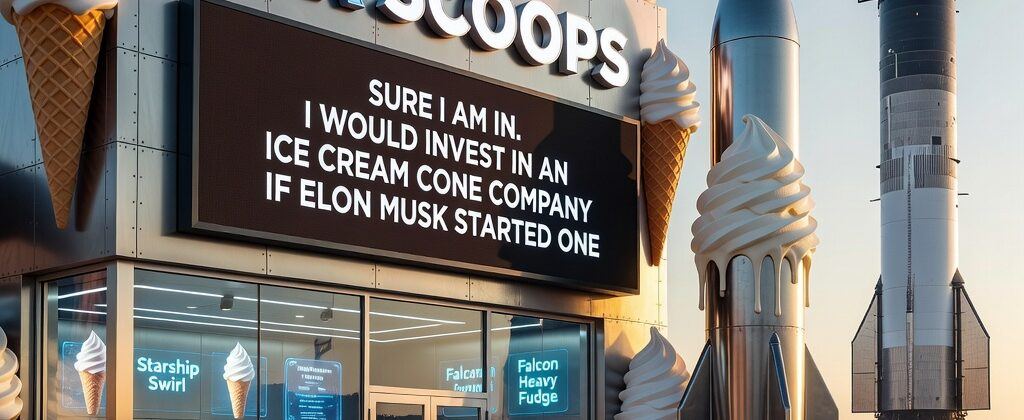
I have a rule I say out loud, usually right before I lose an argument with somebody more sensible than me: if Elon Musk sold ice cream cones, I would invest in the cone company. I am a fan. I have watched this man land rockets backward onto floating barges in the ocean, put a satellite internet network over the entire planet, and turn an electric-car company into one of the most valuable businesses on Earth. So when the largest IPO in the history of the stock market showed up with his name on it, I did not need a lot of convincing. I'm in on SpaceX. I'm putting some money down.
But “I'm a fan, so I bought it” is not a blog post — it's a bumper sticker. What I want to do here at 757BizClick is the thing I actually enjoy: break the whole event down so a casual onlooker and somebody trying to learn this industry both walk away smarter. We'll define the terms (IPO, retail investor, institutional investor, “N of 1”), we'll look at the real numbers, we'll let the pros talk — especially Jim Cramer, who is basically the narrator of this story — and we'll be honest about the other side of the trade, because there is one. Let's make something happen.
What actually happened on June 12, 2026
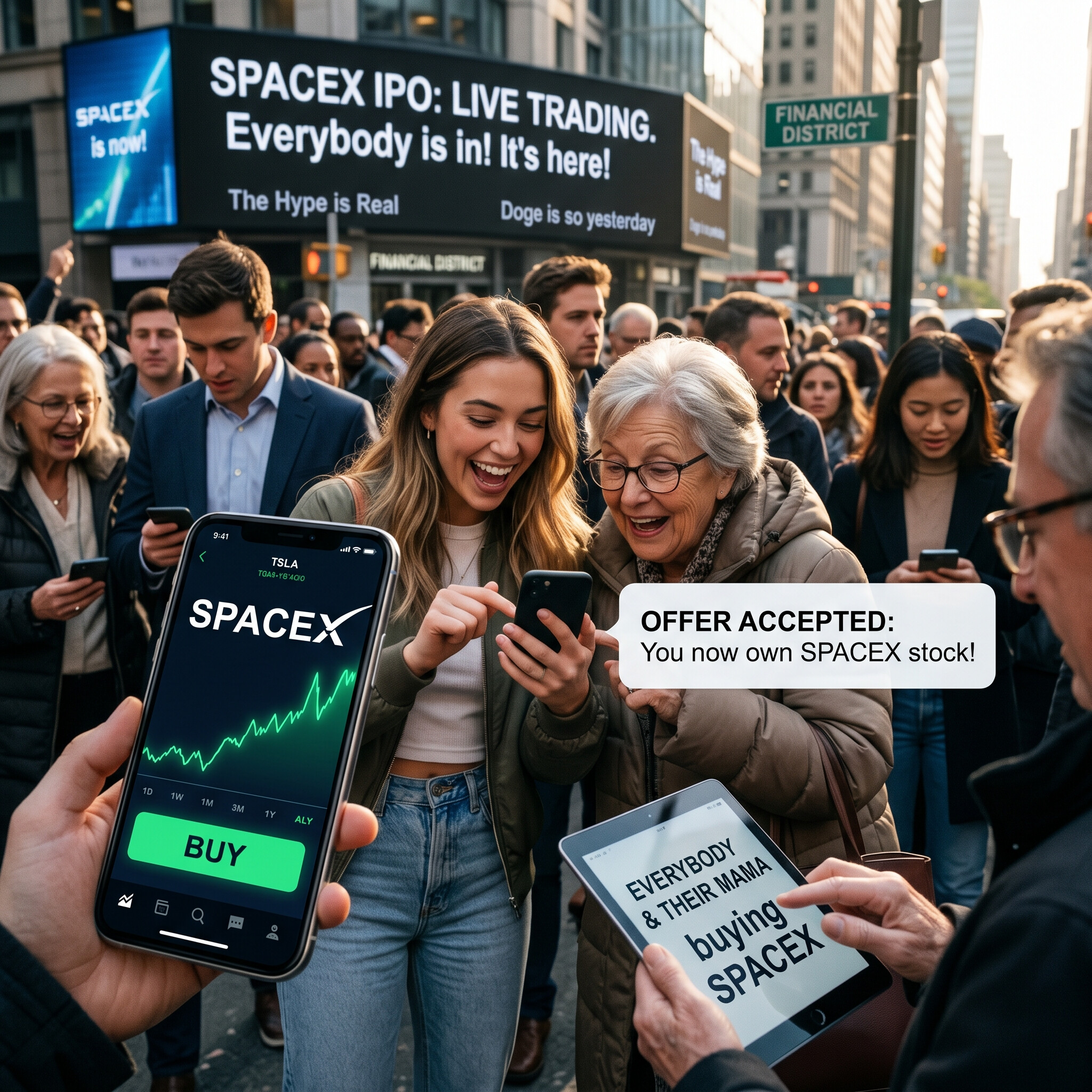
On Friday, June 12, 2026, Space Exploration Technologies Corp. — SpaceX — began trading on the Nasdaq under the ticker SPCX. This was not a normal IPO. It was the biggest one that has ever happened, by a wide margin. Here's the short version, in plain numbers:
- It raised about $75 billion — roughly triple the size of the next-biggest IPO in history. (Motley Fool)
- The company priced at $135 per share, valuing SpaceX at about $1.77 trillion before it ever traded.
- The stock opened at $150 and ran into the $160s within the first hour, briefly pushing the company past a $2 trillion valuation.
- It closed its first day at $161, up about 19%, giving SpaceX a market value of roughly $2.1 trillion. (CNBC)
To give you a sense of scale: in 2025 SpaceX did about $18.67 billion in revenue, and the only piece of the business currently turning a profit is Starlink, the satellite-internet arm. So a company doing under $19 billion in sales priced itself at $1.77 trillion. Hold that thought — it's the bull case and the bear case at the same time, and we'll come back to it.
First, the basics: what is an IPO?
IPO stands for Initial Public Offering. It's the moment a private company sells shares of itself to the public for the first time and starts trading on a stock exchange. Before an IPO, owning a piece of a company like SpaceX is mostly limited to founders, employees, and big private investors (venture funds, family offices, the connected and the wealthy). After an IPO, anybody with a brokerage account — you, me, your cousin, your barber — can buy a share.
A little nerdy history, because I can't help myself: the very first company widely recognized as “going public” was the Dutch East India Company in 1602, which sold shares to ordinary citizens of Amsterdam to fund its trading voyages. That's the great-great-grandparent of what happened with SpaceX on Friday. The technology changed — Amsterdam merchants didn't have a “Buy” button on an iPhone — but the idea is identical: pool the public's money to fund something big and risky, and let the public share in the upside.
Why do companies do it? A few reasons: to raise money for growth, to let early investors and employees finally cash out some of their stake, and to create a public stock price the company can use as currency (for acquisitions, for employee pay, for credibility). SpaceX checked every one of those boxes — and it has some extremely expensive plans to fund, which we'll get to.
What is SpaceX, and what does it actually do?
If you only know SpaceX as “the rocket company,” you're about three businesses behind. As of this IPO, SpaceX is really four things stacked on top of each other:
- Rockets & launch. The original business. SpaceX builds and flies reusable rockets — Falcon 9, Falcon Heavy, and the giant next-generation Starship. Reusability is the whole magic trick: landing and re-flying boosters slashed the cost of getting to orbit and made SpaceX the dominant launch provider on the planet.
- Starlink. The satellite-internet network — thousands of satellites beaming broadband to the ground. This is the part of SpaceX that actually makes money, and reports indicate it now drives the majority of revenue, with as much as 80% of company revenue tied to launching its own Starlink satellites. (Reuters via Yahoo)
- xAI / Grok. Earlier in 2026, SpaceX absorbed Elon's AI company, xAI — the team behind the Grok chatbot — in an all-stock deal that valued the combined company around $1.25 trillion. More on why a rocket company bought an AI lab in a minute.
- X (formerly Twitter). Because xAI had already merged with X, the social platform rode along into SpaceX too.
So when you buy SPCX, you are not buying a pure-play space stock. Wedbush analyst Dan Ives put it bluntly: this is really a data and AI story wearing a rocket costume. That framing matters enormously for how you value it.
Retail vs. institutional investors — and why SpaceX broke the mold
Two terms you'll hear constantly, so let's nail them down.
Institutional investor: A big professional money manager investing other people's money in huge size — mutual funds, pension funds, hedge funds, insurance companies, index funds. They move millions or billions at a time and usually get first crack at IPO shares.
Here's what made the SpaceX deal unusual and, frankly, a little populist: SpaceX set aside roughly 30% of the offering for retail investors. In a typical IPO, regular people get just 5% to 10% — the institutions hoover up the rest. SpaceX tripled the everyday-investor slice. (CNBC) By the end of the day, underwriters estimated roughly $15 billion of the raise came from retail — an allocation they called larger than most IPOs, helped by Tesla's famously loyal individual shareholder base.
Why does this matter? Because it changes who owns the stock and how it behaves. Musk has said he wants long-term shareholders, not flippers. Loading up retail is a bet that fans like me will buy and hold instead of selling the moment we're up 10%. It also means the everyday investor is more exposed here than usual — which cuts both ways. If it goes up, more regular people win. If it gets ugly, more regular people feel it.
Jim Cramer's verdict: “beautifully done”
If this IPO has a narrator, it's Jim Cramer. CNBC's “Mad Money” host has been talking about SpaceX for weeks, and his read is the spine of this whole post — partly because he's been right about the mechanics, and partly because he's a great example of how a pro thinks about a deal like this.
Cramer's bottom line after the first day was about as glowing as it gets. He said he couldn't recall a deal done as well as this one, and in your words and mine, it was an A-plus. Here's the sentiment as you heard it:
“This was beautifully done. This is an A-plus.”
— Jim Cramer, CNBC
But here's the nuance that makes Cramer worth listening to: he didn't actually want the stock to explode. Going in, he warned that a giant first-day “pop” can be a trap. He pointed to Cerebras, an AI chip IPO that popped 89% on its debut a month earlier — and then collapsed more than 35% afterward, leaving everyone who chased the top holding the bag. His ideal? A calm 25–30% gain that rewards holders without inviting the flippers. We got 19% and an orderly close, which is right in his happy zone.
“We don't want an 89% pop like Cerebras. We want a 25–30% pop. People hang on to it and buy more. Not flip it.”
— Jim Cramer, paraphrased from his posts on X
Then Cramer got philosophical, and this is the part I loved. He talked about how, going back 44 years to when the Dow was around 1,000, there have always been people whose entire job is to talk regular folks out of getting wealthy from great companies. Gatekeepers. The “you're not sophisticated enough for this” crowd.
“44 years ago, when the Dow was about 1,000, there were people whose job was to keep regular people from getting wealthy off the great companies. SpaceX is one of those great companies.”
— Jim Cramer, paraphrased
He also framed SpaceX as something bigger than a stock — a patriotic play. His point: America is in a real race with China over space and cars, and owning SpaceX is owning a piece of that competition. And he dropped a hint that I think is the most “Elon” thing about this whole story:
“Elon Musk has some surprises coming — ideas he hasn't shared with the public yet.”
— Jim Cramer, paraphrased
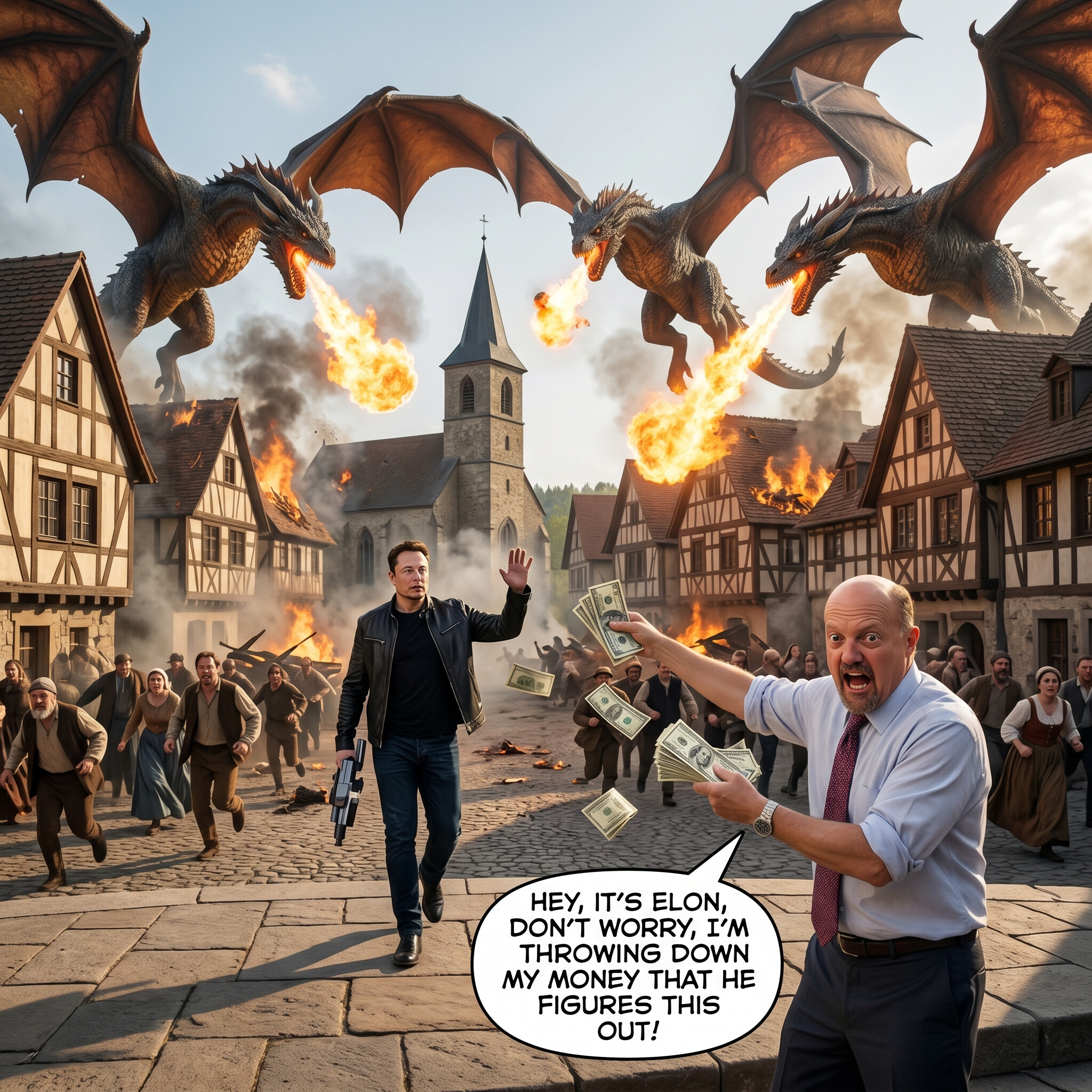
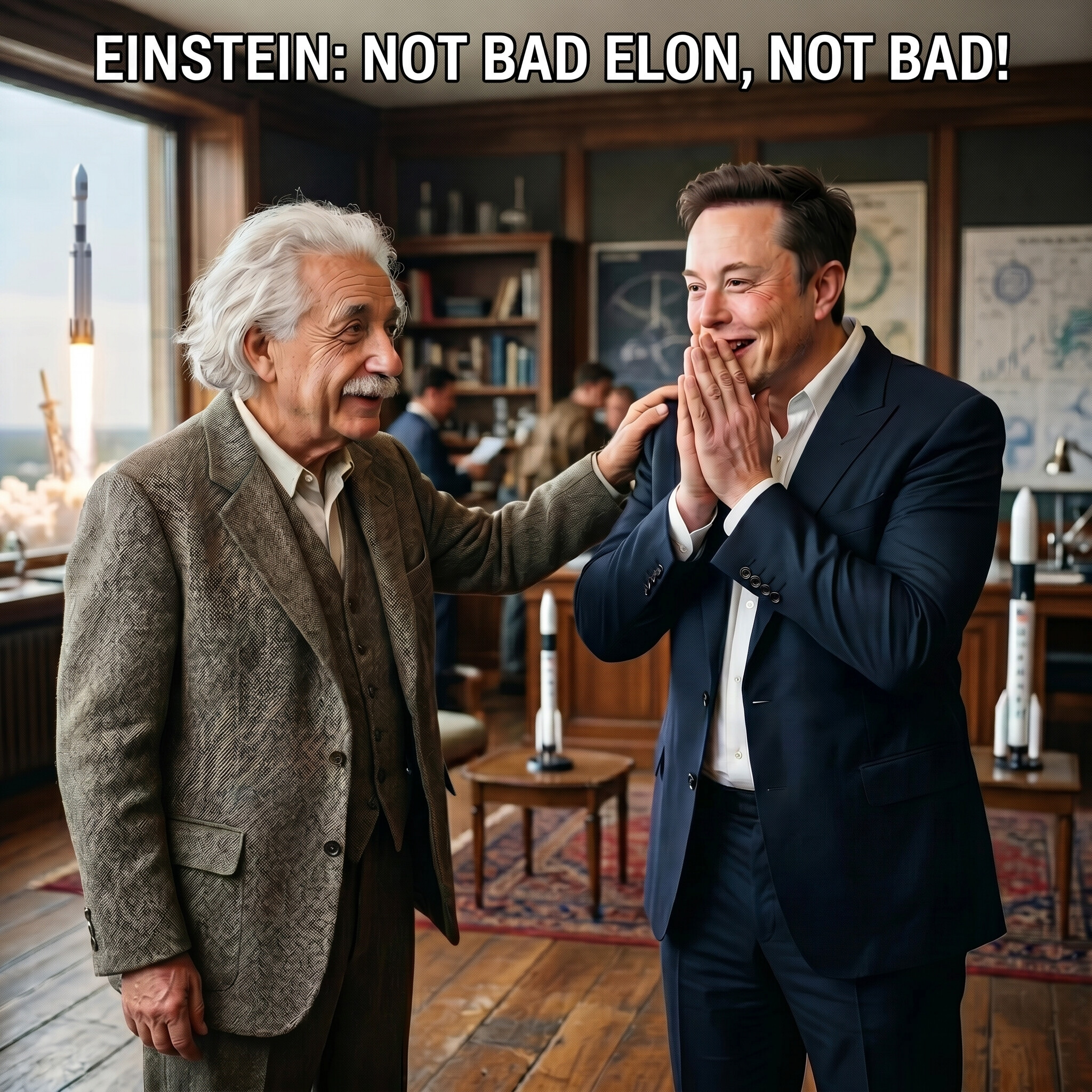
My translation, and the whole vibe of that meme above: Hey, it's Elon. Don't worry. Whether that's wisdom or wishful thinking depends on your stomach — and we'll stress-test it in the risks section. For the full interview, here's Cramer on CNBC breaking down the first day of trading:
Can't see the video? Watch it here: Jim Cramer on the SpaceX IPO (CNBC).
(fixed)
+11.1%
+19.3% total
The Bitcoin parallel: Cramer bets the business, not the feeling
Here's why I keep coming back to Cramer. Years ago, plenty of people — including, at times, Cramer himself — were skeptical of Bitcoin. But when the setup was right, he wasn't too proud to put his own money where his mouth was, and it paid off. The lesson wasn't “love crypto.” The lesson was: separate the investment from your personal feelings about the thing.
That's the exact muscle this SpaceX moment requires — with one big upgrade. Bitcoin is, at its core, a belief system and a network. SpaceX is a real business with real rockets, real satellites, real revenue, and real customers. Same discipline (don't let your gut overrule the math), but applied to something with concrete cash flows underneath it. That, to me, is the strongest version of the bull case: I'm not betting on a feeling, I'm betting on a company that literally has a monopoly-ish grip on getting things to orbit.
(I'm building out a full breakdown of how Cramer thinks about Bitcoin as a backdrop to all of this — read the Jim Cramer & Bitcoin deep-dive here once it's live.)
Tom Lee and the “N of 1” founder
The other pro worth quoting is Tom Lee — co-founder and Head of Research at Fundstrat, former J.P. Morgan chief equity strategist, and one of the most-quoted strategists on CNBC. Lee has a phrase he uses for companies like this, and it's worth teaching because it'll change how you see the valuation debate.

“These are some of the most important companies in the world, led by ‘N of 1' people.”
— Tom Lee, Fundstrat
This is the heart of the valuation fight. Normally you price a stock by comparing it to similar companies (“comps”). But how do you find a comp for a company that builds reusable rockets, runs the world's biggest satellite network, owns a frontier AI lab, and is run by the richest person on the planet who also runs Tesla? You can't. An N-of-1 company breaks the comparison machine. Bulls say that's exactly why the normal valuation rules don't apply and the sky's the limit. Bears say “no comp” is just a fancy way of saying “nobody actually knows what this is worth.” Both can be true at once. Lee himself framed SpaceX as a sizable opportunity for growth tied to AI and data centers — which is the perfect bridge to the wildest part of this story.
Grok, xAI, and why a rocket company bought an AI lab
This is the question that confuses a lot of casual onlookers: why on Earth does a space company own a chatbot? Here's the logic, and it's actually pretty clever.
Modern AI — including Grok, xAI's model — runs on enormous data centers that gulp electricity and need constant cooling. On Earth, that's becoming a genuine bottleneck: power grids are strained, land is scarce, and communities push back. Musk's argument is that global electricity demand for AI simply can't be met with ground-based data centers without serious hardship to communities and the environment. (Reuters via Yahoo)
So Grok's role inside SpaceX is the “why” behind the merger. SpaceX brings the rockets, the satellites, and the orbital infrastructure. Grok and xAI bring the AI workloads that need somewhere to run. Put them under one roof and you get a company that doesn't just launch things — it wants to launch the computers that power artificial intelligence itself. Which leads us to the idea that sounds like science fiction but is being built right now.
The wild idea: data centers in space
Yes, you read that right. The plan is to put AI data centers in orbit. Here's the pitch, and once you hear it, it stops sounding crazy:
- Unlimited solar power. In space, the sun never sets and there are no clouds. Solar panels can run essentially 24/7 at full strength.
- Free cooling. Space is cold and empty. Instead of burning water and electricity to cool servers (a huge cost on Earth), you radiate heat away into the vacuum.
- It scales the thing SpaceX already builds. Reports indicate SpaceX plans to upgrade its Starlink V3 satellites into orbital computing hubs linked by high-speed lasers — turning a satellite network into a space-based supercomputer.
This isn't a one-company daydream. Jeff Bezos and Blue Origin are reportedly chasing the same idea, and startups like Starcloud and others are already launching test hardware with Nvidia GPUs into orbit. The money behind data centers generally is staggering — McKinsey has estimated the industry could spend on the order of $6.7 trillion globally by 2030 to keep up with computing demand. (WSJ via AOL) If even a slice of that moves to orbit, the company that owns the cheapest ride to space owns the on-ramp.
Is it guaranteed? No. The engineering problems are real — radiation can corrupt GPUs, satellites break down and are hard to repair, and stuffing more hardware into orbit raises real concerns about space debris. But this is the optionality you're buying with SPCX. It's the “what if it works” lottery ticket stapled to a real, profitable satellite business.
The euphoria — and the other side of the trade
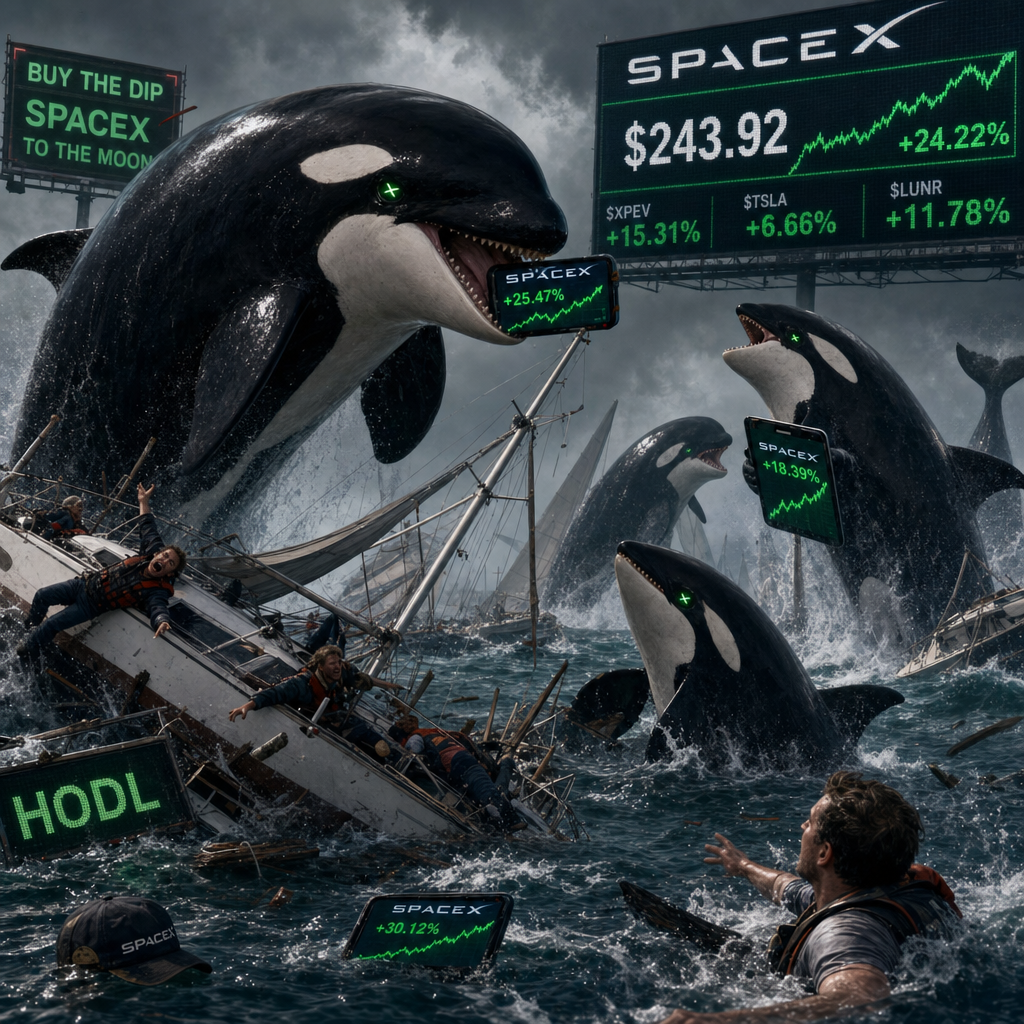
Let's be honest about the mood. The picture below — orcas breaching out of the ocean clutching phones that say “SpaceX +24%,” billboards screaming “BUY THE DIP” and “HODL” — is funny because it's true. This launched into the most AI-drunk market in memory.
The bull case (why I'm in):
- Starlink is a real, growing, profitable business — not a promise.
- Reusable rockets give SpaceX a genuine cost moat in launch; it's the dominant player.
- Massive optionality: Starship, orbital data centers, “Star Trek future” stuff like Zero-G pharmaceuticals and biotech.
- Index funds and ETFs will be forced to buy SPCX as it gets added to benchmarks — steady built-in demand.
- An N-of-1 founder with a 20-year track record of doing things experts called impossible.
- A patriotic, strategic asset in the U.S.–China race over space and EVs.
The bear case (the other side — read this part twice):
- The price. At IPO, SpaceX traded around a price-to-sales ratio of 60 — richer than the most expensive names at the 2021 bubble peak. That assumes near-flawless execution across many bets. (analysis)
- Bears see real downside. Some analysts argue fair value is closer to $75 on the fundamentals — well below the $135 offering price.
- Lock-up supply. After the standard 90-day lock-up expires, insiders can sell, which can flood the market with new shares and pressure the price.
- xAI is burning cash — reportedly around $1 billion a month — and a lot of the “data centers in space” story is still a plan, not a P&L.
- Key-man risk. So much of this rides on one person who is also running Tesla and several other companies.
- Political & regulatory heat. Senator Elizabeth Warren responded to the IPO by calling for a wealth tax and tougher SEC scrutiny. (CNBC)
None of that changes my decision — but it absolutely shapes my position size. I'm in. I'm not betting the rent.
Is SpaceX bigger than an investment? Is it a top signal?
Here's the question that keeps experienced investors up at night. When the largest IPO in history lands at the exact moment that markets are at record highs, AI euphoria is off the charts, and there's even a war dragging on in the background — that's a textbook setup for someone to ask: is this the top? Is SpaceX less of an investment and more of a sign — the bell that rings when the party's almost over?
It's a fair worry, and I won't pretend to have a crystal ball. (For a deeper dive into that exact “is the market about to top?” debate, here's a worthwhile watch: is SpaceX a sign the market is about to top?) But here's the counterweight. Tom Lee — who studies exactly these moments — argued that the coming wave of mega-IPOs (SpaceX, plus OpenAI and Anthropic behind it) probably won't crash the broader market, even though the supply is enormous. And Cramer, after the close, flipped from nervous to constructive, calling the success of the placement “something to be studied for years” and “a win for the market” — with the caveat, “if we get peace.”
My honest take: tops are only obvious in the rearview mirror, and the people who sat out every great company waiting for the “safe” moment are the same gatekeepers Cramer was talking about. The move isn't to go all-in or to hide. The move is to take a real position in a real company and manage the risk. Which brings me to the most important business idea Elon hasn't announced yet.
So… what would Elon's ice cream cone company be called?
Remember my rule: if Elon Musk sold ice cream cones, I'd invest in the cone company. Well, the internet already named it for me, and it's perfect — BFR Scoops.
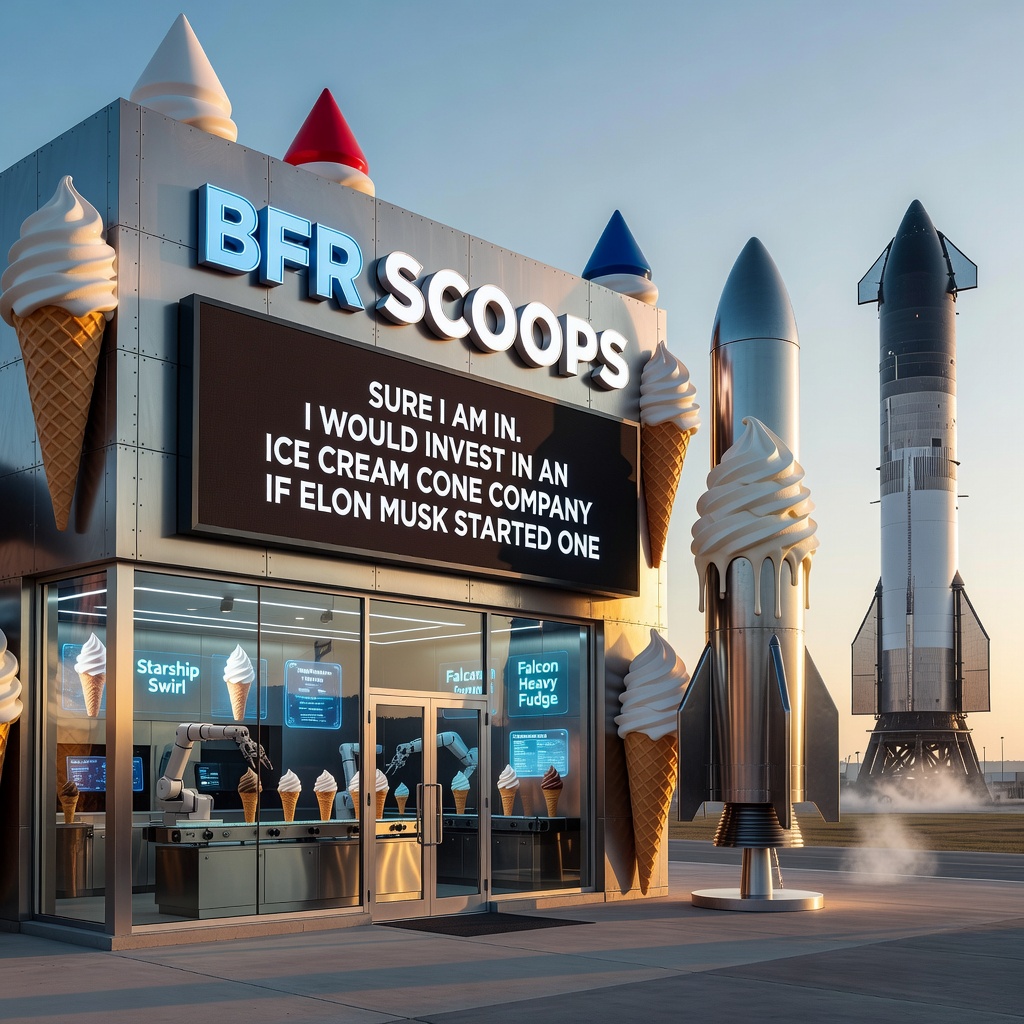
For the uninitiated, “BFR” was SpaceX's old nickname for the Big Falcon Rocket. As an ice cream brand it works on every level. And since I'm a sucker for a good brainstorm, here's the rest of the menu Elon should trademark immediately:
- Starship Swirl — soft serve, obviously.
- Falcon Heavy Fudge — three scoops strapped together, two of them you can use again.
- Reusable Rocky Road — finish the cone, the cone comes back.
- Grok Mint Chip — it explains the flavor to you, whether you asked or not.
- Occupy Mars Mango — red, naturally.
- The Boring Vanilla — comes in a tunnel.
And here's where the joke turns into a jab. The detractors keep saying SPCX is “overpriced,” “a bubble,” “irresponsible.” My response? I would put money into Elon's ice cream company. So you're telling me I should pass on the actual reusable-rocket, planet-spanning-internet, frontier-AI, race-against-China company because the price-to-sales ratio offends you? Respectfully — I'll take the cone and the company. (And yes, I'm doing a whole separate SpaceX IPO meme drop soon — pure memes, a few hard facts, all fun. Bookmark it. The memes are the show; this post is the receipts.)
My take: I'm in
So that's where I land. SpaceX is the rare case where the fan and the investor in me agree. The fan loves the rockets and the audacity. The investor sees a real, profitable Starlink business, a dominant launch monopoly, an N-of-1 founder, forced index demand, and a stack of moonshot optionality (literally) in AI and orbital data centers. Cramer called the deal beautifully done. Tom Lee called it a sizable growth opportunity. And the gatekeepers, as always, are telling regular people to stay away from a great company.
I'm putting some money down. Not the rent — a real position I can hold through the noise. Because the whole point of 757BizClick is to learn this stuff, think clearly, and then make something happen.
Disclaimer: This article is for educational and entertainment purposes only and reflects the author's personal opinions. It is not financial, investment, legal, or tax advice. I am not a licensed financial advisor. Investing in stocks — especially newly public, highly valued ones — carries real risk, including the loss of your entire investment. Do your own research and consider speaking with a qualified professional before making any investment decision. Some links above are affiliate links, meaning 757BizClick may earn a commission at no extra cost to you.
757BizClick · Make Something Happen · 757-681-8900 · 757BizClick@Gmail.com

Leave a Reply