
 by
by 
Quick heads-up: a few of the links below are affiliate links. If you start something through one of them, I may earn a small commission at no extra cost to you — and I only point you toward tools I actually use or genuinely believe in.
The Permanent Underclass started out as a thought I had all by myself.
A few years back I started watching where artificial intelligence and robotics were heading, and I followed the logic all the way to the end of the line. I never had a fancy name for it. I just kept landing in the same uncomfortable place: in a world where machines do most of the work, a few people are going to have almost everything, and a whole lot of people are going to have almost nothing. Not because somebody twirled a mustache and planned it that way — but because that’s where the math points if nothing changes. Economic physics, not intention. And the few at the top would have so much wealth, power, and influence that, next to everybody else, they’d practically be gods.
I figured it was just me overthinking things. Then I found out there’s a name for this exact idea, and it’s been circulating for a while now: the permanent underclass. I’ll be honest, I was a little shaken when I saw it. It wasn’t just me. A lot of people — including some of the smartest folks building this future — are staring at the same horizon and seeing the same thing.
So let’s talk about it. Not to scare anybody — the opposite. I want to lay it all out: the theory, the real numbers, the history, and most importantly what a regular person can actually do about it. Then I’ll let you decide for yourself. Because here’s my honest take — this is one of the greatest moments in human history to start a business and to invest. The door is open right now. I’d much rather you walk through it with your eyes open than stand outside of it scared.
And if you’re already thinking “okay, but where would I even start?” — I’m going to keep pointing you to the same low-cost door I walked through myself. It’s called Wealthy Affiliate, about $50 a month. More on that as we go, but here’s the link if you like to look ahead: Learn to build an online business with Wealthy Affiliate »
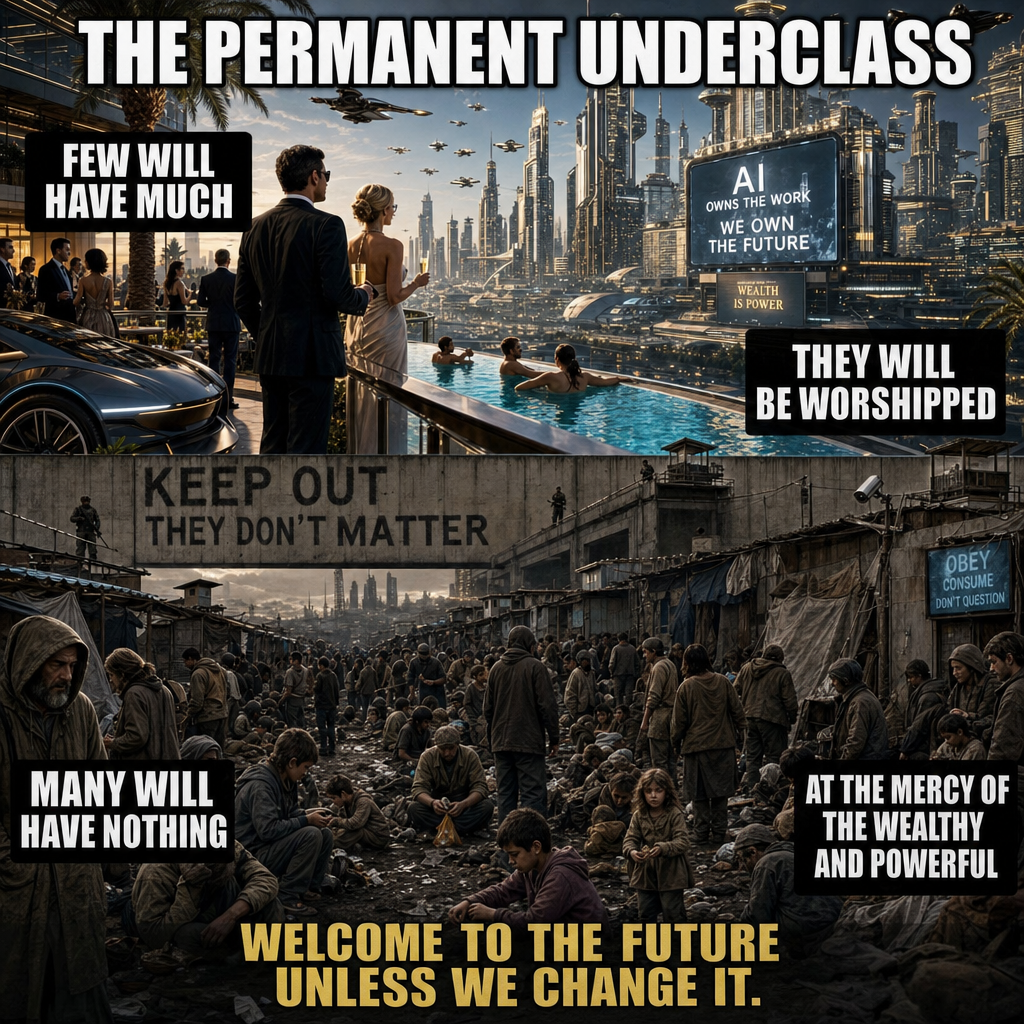
The Permanent Underclass Theory
Here’s a video worth watching on this before we dig in — then let’s break it down together.
Here’s the short version. Artificial intelligence and robotics are starting to do the things human beings used to get paid for — first the routine stuff, and now creative and “thinking” work too. As that spreads, the people who own the AI, the robots, the data centers, and the companies capture more and more of the value, while the people whose main asset is their labor have less and less to sell. Run that forward far enough and you get two groups: the people with wealth, power, and influence, and everybody else. And here’s the part that makes it “permanent” — there’s almost no ladder between them.
Now, I’m a huge Elon Musk fan. I’m invested in what he’s building and I believe in the vision. But I’ll ask the honest question anyway: what is the value of human labor when 50 million Optimus robots roll off the assembly line and into everyday life? Look at the balance sheets of the companies tied to AI and robotics — trillions of dollars are pouring into AI, quantum computing, and space. That money isn’t sentimental. It’s a bet on a future these folks can already see coming.
Let me be fair, though, because I’m not here to sell you fear. This could also turn out to be a bust — or at least a lot slower and smaller than the hype. Right now a lot of the money is being counted but not actually made at the scale everyone keeps promising. The optimists say AI will create whole new categories of work we can’t even imagine yet — and that has been true in every past technology wave. The skeptics have a point too. Nobody actually knows how this turns out socially, culturally, or economically. We can only reason from how the world tends to work, what the experts are saying, and plain old common sense applied to the past.
Elon and others put it gently: in the future, you’ll be able to work “if you want to.” And that might even be partly true. But read it again. “If you want to” quietly means most people won’t be needed to. And when you’re not needed, you don’t get to set your own terms.
Here’s the comparison that makes it real for me. You know the caste system — where the class you’re born into is basically the class you die in, with no real way to move up? Strip away the religion and the culture, and that’s what a permanent underclass is, just drawn in dollars instead. An economic caste. Think about it: the families of the people we already call rich — the Gateses, the Musks, the Jordans, the Winfreys, the Jay-Zs, the political dynasties on both sides of the aisle — those families are likely to stay rich for generations. And the theory says that sometime in the next decade, a lot of everybody else gets locked in wherever they happen to be standing. After that, the main ways across the line are the old ones: marry into it, or get adopted into a family or a community that already has it.
Why do the wealthy stay safe? Because in a machine-run world they still hold the things machines can’t print: prestige, relationships, fame, connections, rare skills, and influence. When it comes to the tech giants and the industries that really matter, very little works — or works as well — without them. That’s leverage. And leverage is exactly what becomes priceless when ordinary labor becomes cheap.
And watch what’s happening at the very top right now. Tech, big business, the military, and government are merging. National defense, the economy, and the state are increasingly the same conversation — you can see it in the tech billionaires lined up at the inauguration. The people in Silicon Valley building these models, the folks at the chip companies — a lot of them know exactly what they’re sitting on. They can see themselves becoming the kings and queens of whatever comes next.
Which leaves the hardest question in the whole theory, and I’m just going to say it plainly: if most people aren’t needed for the day-to-day running of society, what is their purpose? What do they actually do? Some people fear the answer is “servants” — or, God forbid, something worse. I don’t raise that to be dramatic. I raise it because that fear is exactly why I refuse to sit still. (I dig deeper into the job-destruction side of all this in my post on AI, robotics, and the future of work.)
(Quick aside, because sometimes you’ve got to laugh or you’ll cry: people are already selling permanent underclass merch. They’ve turned the whole thing into a joke. Ha. Okay. Let’s just make sure we end up on the right side of that joke.)
Opportunity Cost — The Clock Nobody Set for You
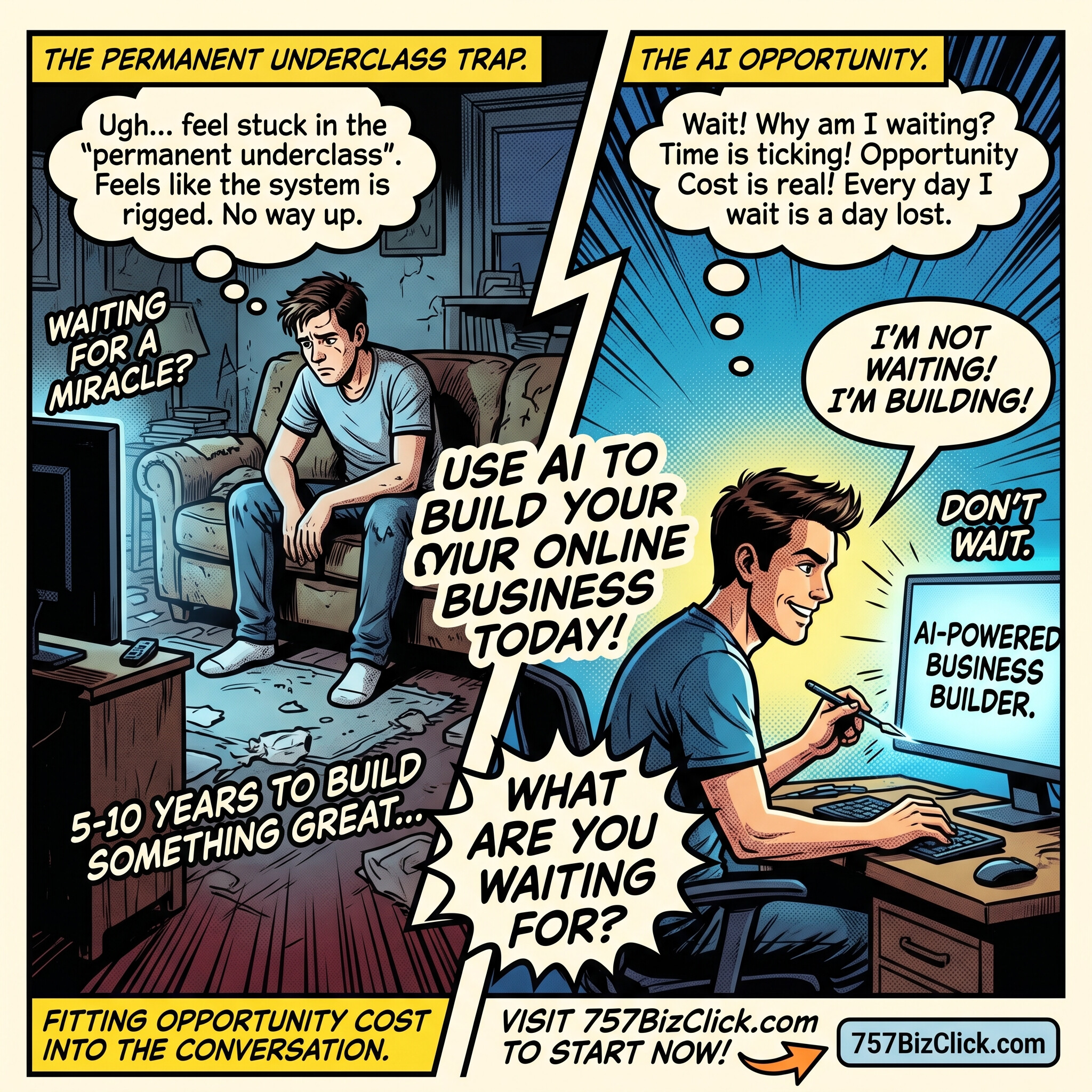
Let me bring in a concept that changed how I see everything: opportunity cost. I won’t give you the whole economics lecture. Here’s all you need: the real cost of anything isn’t just the money or the time it takes — it’s whatever you gave up to do it instead. Every hour, every dollar, every year you spend on one thing is one you can’t spend on another. The cost is the road you didn’t take.
Now apply that to this moment. When people say we’ve got five to ten years, they’re making an opportunity-cost argument whether they realize it or not. They’re saying the cost of waiting is the window itself — the stretch of time where audiences, businesses, ownership, and AI-powered income are still cheap and within reach. Early movers buy their position at a discount. Late movers pay full price, or show up to find the door already shut. “Don’t be trapped” really just means: don’t ignore what standing still is costing you, because that cost compounds the entire time you sit.
Now I’m going to be straight with you, because you deserve honesty and not a pitch. Opportunity cost is brutal when your only real asset is your labor. Time doesn’t compound, and you never get it back. Every hour in a job a machine is about to do is an hour you didn’t spend building something you own or learning something the machine can’t do yet. And here’s the cruel part: the people most exposed to automation — entry-level workers, lower-wage workers — are exactly the ones with the least room to pay that cost. To retrain or build, you need surplus: a little savings, a little time, the freedom to try and fail. If you’re working two jobs just to keep the lights on, the “opportunity cost” of building for the future can look like going hungry tonight. In that sense, opportunity cost is almost a luxury good — and that’s a big part of why the system can feel rigged, and why “just go start a podcast” advice has a cruel edge for the people who can’t afford the price of acting.
I sat with that hard truth for a while. And here’s where I land — where I maybe see it a little differently than the gloomy version.
I still believe that in this country, even the poorest among us have a real shot at going from rags to riches — or at least rags to better, and then scaling from there to a decent place. I really do. But most of the time, the thing standing in the way isn’t money. It’s three things we were never handed: information, the right mindset, and support. Nobody in our communities is sitting us down saying, “hey, learn how to use AI to start a business.” It’s more like — somebody saw the funny AI picture I posted on Facebook. Ha. When I tell family I’m using AI to build my business, they look at me sideways and change the subject. The same family that tells me not to invest in the stock market and doesn’t believe I can build anything. That’s not a money barrier. That’s an information-and-belief barrier. And those, we can fix.
Most of us — me included — were never taught opportunity cost at all. We were taught to keep our heads down, work an honest job, and trust that everything would work out. Then life got harder and harder, and a lot of us realized nobody was coming to explain the rules. I had to learn the hard way that you have to get smarter with your income — build multiple streams, and not weak ones, powerful ones — and then take the money those streams produce and put it into bigger and better businesses and assets, through real estate, the stock market, and other things that actually grow.
And here’s the part that flips the whole “luxury good” problem on its head, at least today: the entry toll has collapsed. Real education used to cost a fortune. The platform I learned on runs about $50 a month. The amount the average person spends eating out in a single month dwarfs what it costs to start making money online. I’ll go further — I think a lot of people would out-earn me online faster than they’d ever believe, if somebody had just told them two things: that they needed to start, and how much was actually possible. The way I personally pay my opportunity cost is simple: I borrow the tools the asset owners and big businesses already built — the internet, social media, AI — and I use them to build my own thing. A website. E-commerce. Affiliate marketing. Content on social. Low cost to no cost to get in the door, and then you scale from there. (If you want the money side of this — financial literacy and investing in this new economy — I broke it down in this post.)
This is that low-cost door I keep mentioning. The classroom I actually learned in is Wealthy Affiliate — around $50 a month to learn how to build an online business the right way. If reading this lit even a small fire in you, that’s where I’d send you: Start your online business with Wealthy Affiliate »
The Spender vs. the Builder / Asset Collector
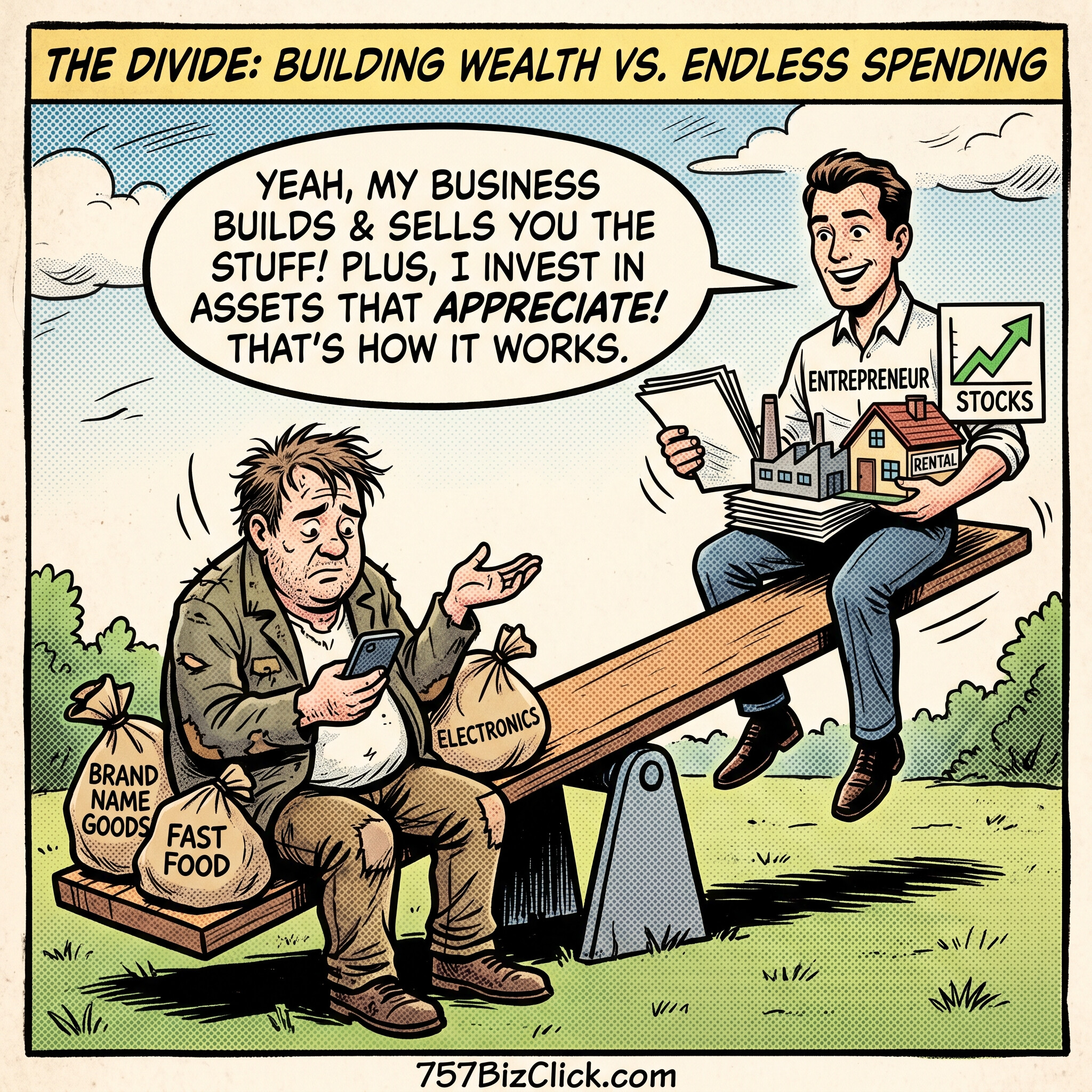
This next part is the heart of everything I teach, so stay with me. Take a single dollar.
In a spender’s hand, that dollar buys a thing, and it feels like it’s gone. But it’s not gone — it just moved. It landed in the pocket of whoever owned the thing that got sold. In an owner’s hand, that same dollar buys a productive asset that then earns more dollars — including the spender’s next dollar. So every single act of consumption is a quiet transfer from the person who buys to the person who owns. Strip away all the noise and an economy is basically one giant machine for moving money from the people who spend it to the people who own the things it gets spent on. The builder sits at the collection point. The consumer feeds it.
Once you see that, you can’t un-see it. And the numbers back it up hard. Here’s one that stopped me cold: as of late 2025, the top 1% of U.S. households hold a record 31.7% of all the wealth in the country — roughly $55 trillion, which is about what the entire bottom 90% holds combined. The top 10% own about 68% of all the wealth and more than 87% of all the stocks. The bottom half? Around 2.5%. And look at the spending side: the top 10% of earners now account for nearly half of all consumer spending — but because that spending is a small slice of their income, it barely dents them, while the rest of their money compounds. Meanwhile the wealthiest households pushed their savings rate from about 43% up past 54% since the 1980s, while everybody else’s savings rate fell. Economists literally call it “the saving glut of the rich.” The rich save and own; lower-income families often spend every dollar they make just on necessities — sometimes more, going into debt just for the basics.
Here’s what really gets me, though, and it’s why I don’t think any of this is some brand-new AI conspiracy: this is the oldest story there is. Only the asset changes. In the old days, the asset was land — the lords owned it, the peasants worked it, and the rent flowed up. Then it was capital — the factories and machines — owners on one side, workers on the other. Since about the 1980s the asset went financial — stocks, real estate, equity. And now the asset is becoming AI, compute, data, and audience — the most scalable one yet, because it copies for almost nothing and barely needs workers. Different costume, same play, for five thousand years: whoever owns the productive asset of the age keeps the surplus made by the people who only bring their labor.
And here’s the part that’s right in my wheelhouse, because I came up in sales: the trap is also psychological. The whole consumer side is engineered to keep you spending — the ads, the feeds, the algorithms, buy-now-pay-later, subscriptions on everything, and the oldest hook of all, status. People buy liabilities they think are assets — the financed car, the upgraded phone, the lifestyle that looks rich — things that pull money out of your pocket every single month. The wealthy quietly do the opposite: they buy assets that put money in. (Funny thing the research shows — a lot of truly wealthy people actually under-spend relative to what they make, while plenty of big spenders are broke.) Buying stuff feels like freedom because you’re making choices. But it’s the exact opposite of building freedom.
Look at Magic Johnson. He made his money playing basketball and doing endorsements — and then he made a choice. He could’ve bought the biggest yacht, the finest cars, the largest house in the city. Instead he bought movie theaters, real estate, and pieces of professional sports teams. He put his money to work so it would earn for him, instead of working his whole life for money. Now — I’ll say it the honest way: that choice is not as easy for someone on the lower income rings. It’s harder. But it is still a choice. Invest in education, in a business, in assets — or spend it. (Two of the lowest-cost ways I know to start building instead of just spending: affiliate marketing and stacking cash back through Rakuten — and here’s my Rakuten link if you want it.)
Build a Business and Invest Over the Next 10–15 Years — Using AI
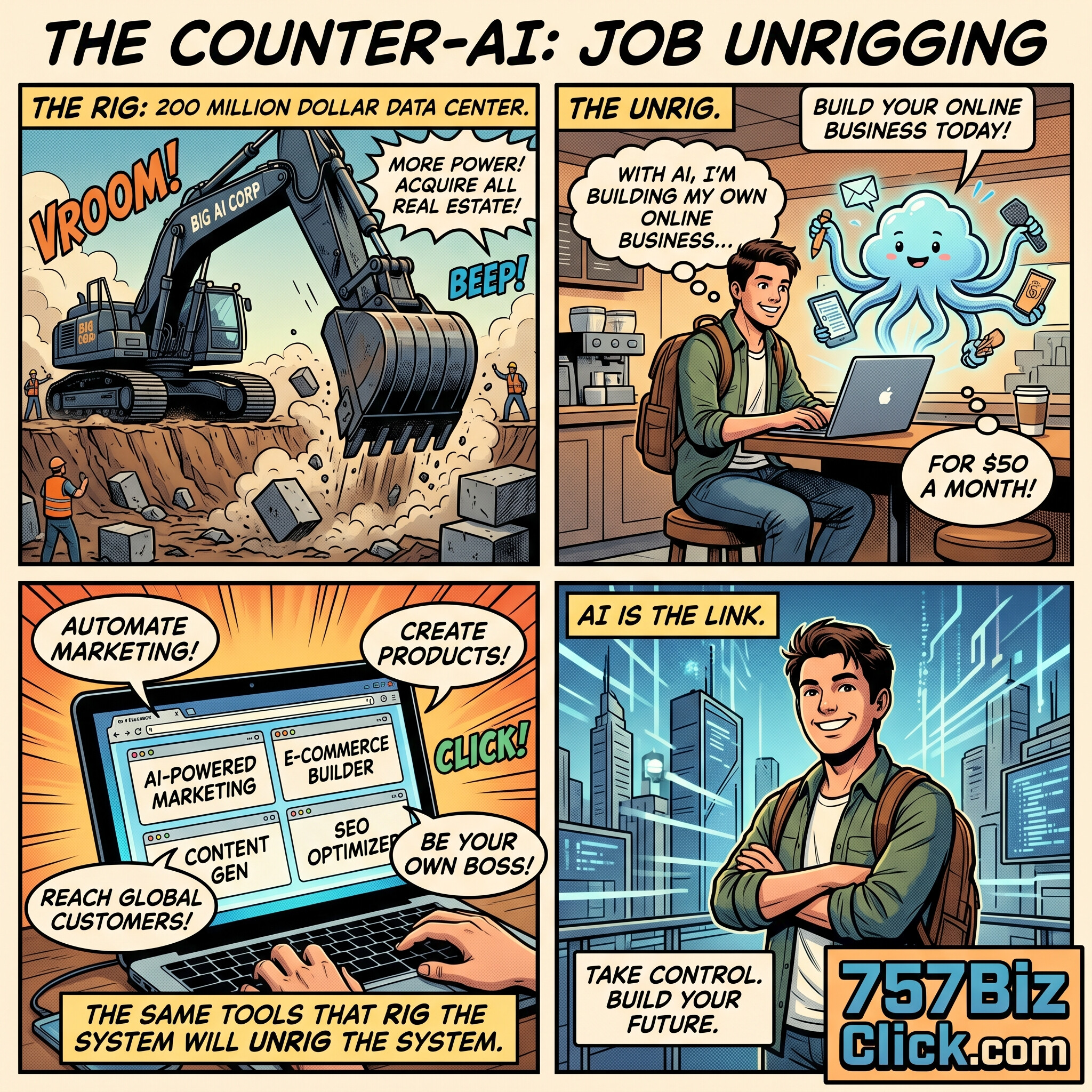
So what do we actually do with all of this? Here’s my whole philosophy in one line: the same tools that are rigging the system can un-rig it for you.
That giant data center, that AI model the big corporation spent a fortune on? You don’t need to own it. You just need to use it. AI is the great equalizer here. If AI is letting Elon Musk scale, then AI can let me scale too — and it can let you scale. Not at his level, sure. But from where you’re standing now to a much better place? Absolutely.
Here’s the playbook I actually run, and it’s not complicated:
1. Build something you own. A website. An e-commerce store. An affiliate business. A presence on social media that points back to your thing. The entry cost is low to nothing, and AI now does the heavy lifting that used to take a whole team — writing, design, marketing, customer service, product research. Then you scale from there.
2. Use AI to work both sides at once. This is the key. Use it to build your business and to free up money and time to invest in great businesses you’ll never run. That’s the move the wealthy make, and you can copy it: you don’t have to be Elon to win from what he builds — you can own a piece of it. (That’s exactly why I wrote up the SpaceX IPO — ride the coattails of the people building the future, all the way up.) Take the income your business produces and pour it into assets — stocks, real estate, ownership — so your dollars start pulling the same direction the rich man’s dollars pull.
3. Stack powerful income streams and feed them back into assets. One stream is fragile. Several strong ones, each feeding the next and feeding your investments — that’s how an ordinary person quietly crosses from the spender side to the builder side over ten or fifteen years.
And here’s the honest math on why to do this even if the whole permanent-underclass thing turns out to be overblown. Look at the asymmetry. If you spend the next decade building a business and some investments, and the scary future never arrives — congratulations, you built a business and some investments. You win. But if you don’t, and it does arrive — you’re stuck on the wrong side with no leverage. When one path wins in almost every scenario and the other only loses in the bad one, that’s not really a gamble. That’s just the smart bet.
If you want the exact place I learned to do this — building an online business with these tools, step by step — it’s Wealthy Affiliate. About $50 a month, beginner-friendly, with a community that actually wants you to win. Take a look at Wealthy Affiliate » That last part matters more than people think — remember the family looking at me funny? Surround yourself with people who are building.
So — What Are You Going to Do?
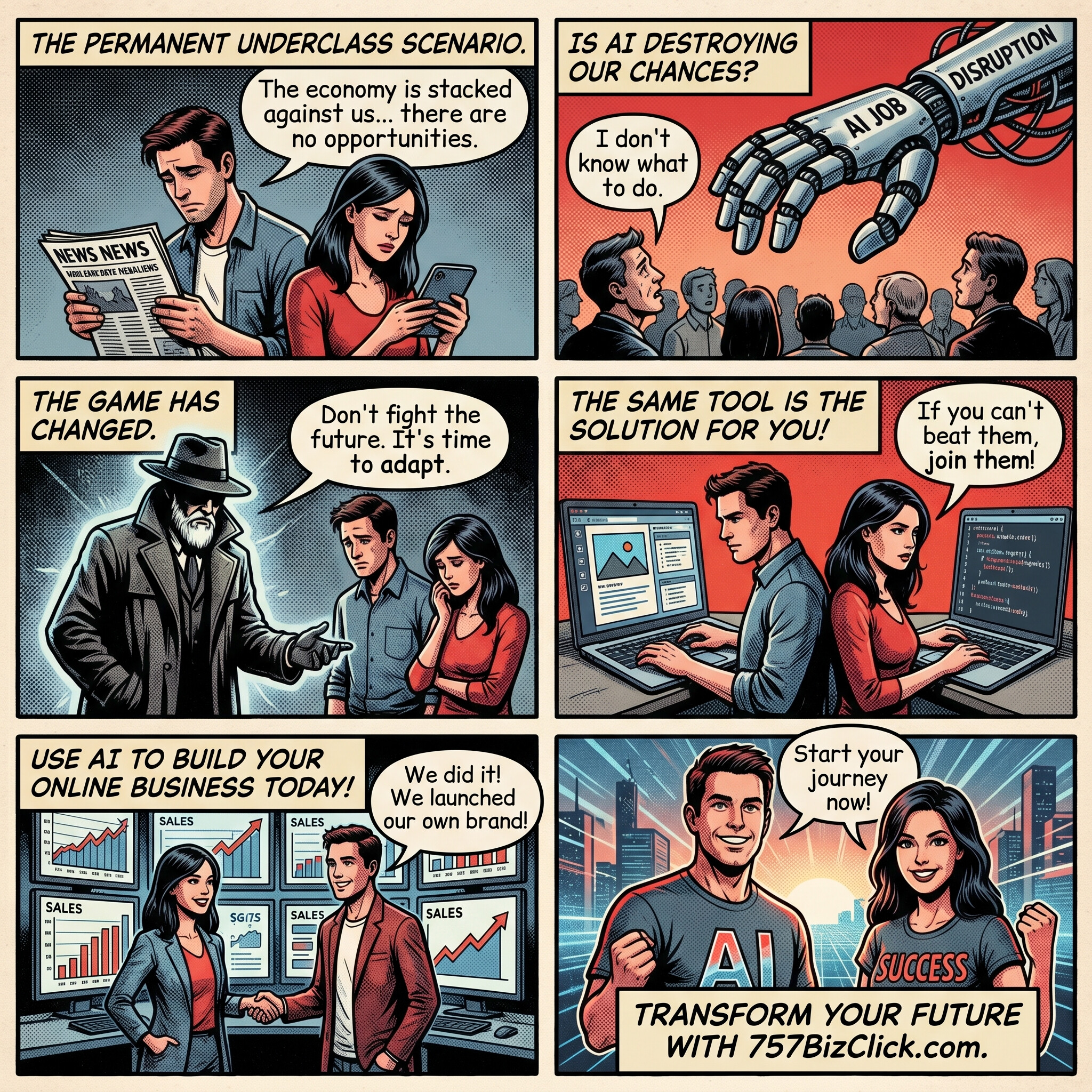
I’m going to leave the deciding to you, because that’s the whole point. But let me ask you straight:
Do you feel threatened by what AI and robotics are going to do to our economy and our society? Do you believe a permanent underclass could actually happen? And if it could — what should we be doing right now to keep ourselves and our families off the bottom rung?
Here’s where I land. I don’t think any of this is a reason to be bleak. I think it’s a reason to get on your horse and start riding. Because look at where we are: we’re living in one of the most incredible windows in all of human history to start a business and to invest. The tools the giants spent fortunes building are sitting right there for you to pick up for a few dollars a month. That’s not a tragedy. That’s an open door. Let’s go get our piece of the pie.
Don’t play games. Get on your horse and start riding — with a purpose.
When you’re ready to actually start, here’s the door I keep coming back to: Start building your online business with Wealthy Affiliate » Walk through it, and let’s make something happen.
A few things if you want to go deeper. I haven’t personally read these books, but from what I can tell they dig into this same territory, and they might help you think it through: Class Warfare in the 21st Century and The Last Human Job.
Got questions, push-back, or your own take on the permanent underclass? I want to hear it — drop it in the comments. Let’s figure this thing out together, and let’s build. — Cedric, 757 Biz Click


Leave a Reply